
BMW N57 3.0 Diesel Engine Guide: 150, 180, 190, 230 kW Versions, Applications, Common Block Problems & Repair
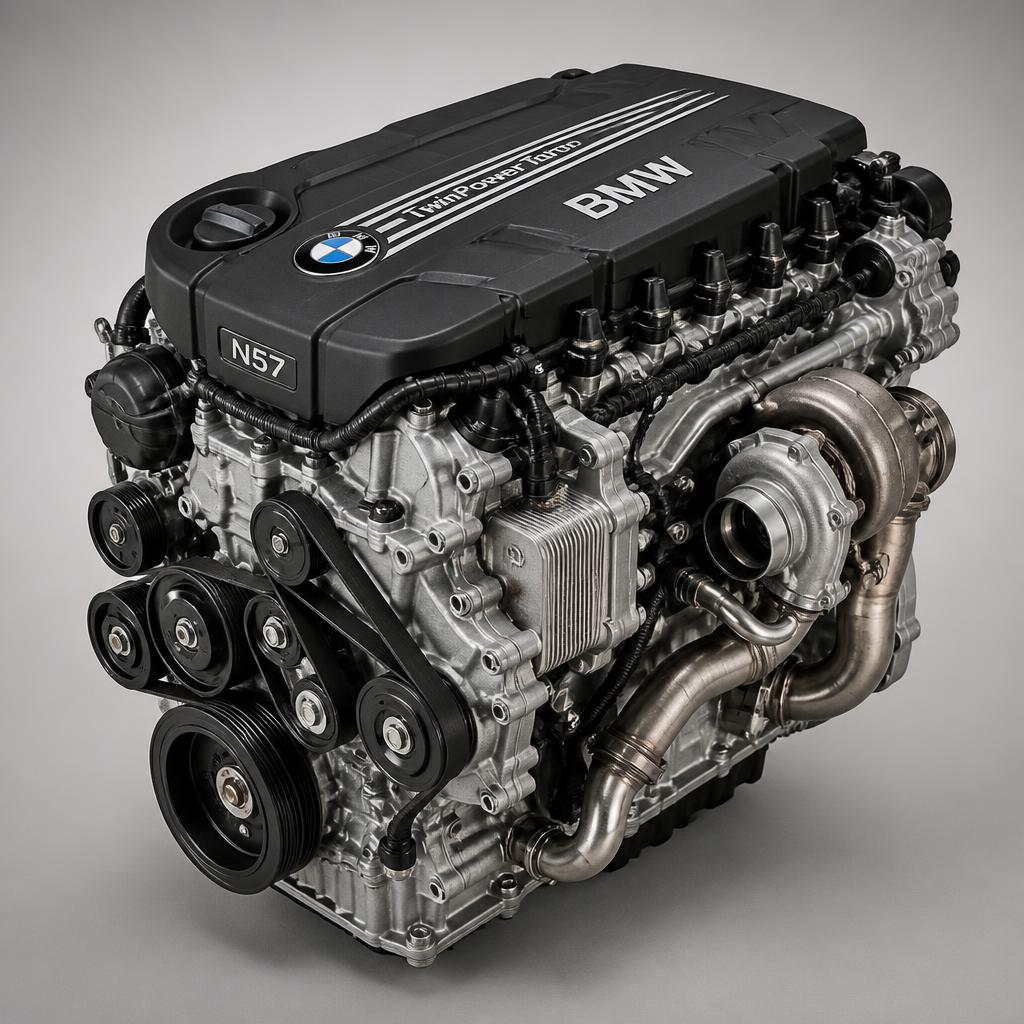
The BMW N57 is one of the most successful modern diesel engines ever produced by BMW — a 3.0-litre inline-six turbo diesel that replaced the legendary M57 in 2008 and remained in production until 2019. Fitted to virtually every rear-wheel-drive BMW from the 1 Series to the 7 Series, the X3, X4, X5 and X6, plus Range Rover, Range Rover Sport and even the Morgan Plus 6, the N57 comes in four main power outputs — 150 kW, 180 kW, 190 kW and 230 kW — using single, twin or even tri-turbo setups. This guide walks through every version, the cars they were fitted to, the common engine block problems to watch for, how repair and maintenance actually play out, and where to source a quality used N57 replacement.
What is the BMW N57 Engine?
The N57 is a 6-cylinder inline diesel with an aluminium crankcase, cast-iron cylinder liners, aluminium head, DOHC 24-valve architecture, common-rail direct injection with piezo injectors, and variable-geometry turbocharging. It was designed as a lighter, cleaner and more powerful evolution of the iron-block M57.
- Displacement: 2,993 cc
- Configuration: Inline-6, turbocharged diesel
- Bore × stroke: 84 × 90 mm
- Block: Aluminium with cast-iron liners
- Head: Aluminium, DOHC, 4 valves per cylinder
- Injection: Bosch common rail, piezo injectors, up to 2,200 bar
- Turbocharging: Single VGT, twin-turbo (N57S) or tri-turbo (N57S with three chargers)
- Emissions: Euro 5, Euro 6, Euro 6d — with DPF, EGR and (later) SCR/AdBlue
N57 Versions by Power Output
N57D30 — 150 kW / 204 HP
The entry-level single-turbo N57. VGT turbocharger, 400–430 Nm of torque, refined and economical, this is the version most owners will encounter. Applications include:
- BMW 325d / 330d (E90/E91/E92/E93, F30/F31/F34)
- BMW 525d / 530d (E60/E61, F10/F11 lower-power variants)
- BMW 725d / 730d (older F01 markets)
- BMW X3 xDrive30d (F25)
- BMW X5 xDrive30d (E70/F15 base variants)
- BMW X6 xDrive30d (E71)
N57D30 — 180 kW / 245 HP
The mid-power single-turbo version, still a single VGT charger but with revised injection and boost mapping. 500–540 Nm of torque. Fitted to:
- BMW 330d / 335d single-turbo variants
- BMW 530d (F10/F11)
- BMW 730d (F01/F02, later G11/G12)
- BMW X3 xDrive30d
- BMW X5 xDrive30d (F15)
- BMW X6 xDrive30d
- Range Rover / Range Rover Sport TDV6 3.0 (SDV6 in some markets)
N57D30TOP / N57S — 190 kW / 258 HP (some markets 230 kW)
Depending on market and vintage, the higher-output N57 appeared as 190 kW / 258 HP with 560 Nm, typically using a twin-turbo (bi-turbo) sequential setup — one smaller high-pressure turbo and one larger low-pressure turbo. Applications:
- BMW 335d xDrive
- BMW 535d / 535d xDrive (F10/F11)
- BMW 640d (F12/F13/F06)
- BMW 740d (F01/F02, G11/G12)
- BMW X3 xDrive35d
- BMW X4 xDrive35d
- BMW X5 xDrive40d
- BMW X6 xDrive40d
N57S — 230 kW / 313 HP (Bi-turbo & Tri-turbo M Performance)
The flagship N57. In its most famous form it is the tri-turbo engine developed for the M Performance models — one small, one medium and one large turbocharger arranged for seamless boost across the rev range. Peak output: 230 kW / 313 HP and up to 630 Nm of torque. Some markets and later F-generation cars also list a 230 kW twin-turbo variant. Applications include:
- BMW M550d xDrive (F10/F11) — tri-turbo
- BMW X5 M50d (F15) — tri-turbo
- BMW X6 M50d (F16) — tri-turbo
- BMW 750d / 750Ld xDrive (G11/G12) — quad-turbo B57 evolution replaced it, but late N57S 230 kW units exist in earlier 750d
For years the tri-turbo N57S held the record as the most powerful production 3.0-litre diesel in the world.
Common N57 Engine Block & Bottom-End Problems
The N57 is generally very durable — 400,000–500,000 km is not unusual with disciplined maintenance — but a handful of block and bottom-end issues are worth understanding before you buy, repair or replace one.
1. Timing Chain Wear (Rear-Mounted Chain)
The N57's timing chain is at the rear of the engine, against the bulkhead. Early N57 units (roughly 2009–2011) suffered chain stretch and guide wear, occasionally leading to chain failure and catastrophic valve-to-piston contact. Symptoms: rattle on cold start, rough running, DTCs for camshaft correlation. Because the chain is rear-mounted, replacement requires the gearbox or engine to come out — a very expensive job (typically €2,500–€4,500 in labour alone).
2. Swirl Flap Failures
Early N57 intake manifolds have swirl flaps that can break off and get sucked into a cylinder — destroying the pistons, valves and often scoring the cylinder liners. This is one of the most common causes of a scrap N57 block. Removal or delete kits are widely available and highly recommended as preventive work.
3. EGR Cooler Cracks & Coolant Loss into the Combustion Chamber
The N57's EGR cooler is prone to cracking. When it fails, coolant enters the intake and combustion chambers, causing white smoke, coolant loss, and — in the worst cases — hydro-lock that bends a con-rod and cracks the block. EGR cooler recalls covered many models but not all.
4. Crankcase Ventilation (Oil Separator / CCV)
The plastic CCV / oil separator can fail, causing heavy oil consumption, blue smoke, and increased crankcase pressure. Left unaddressed, it can push oil past turbo seals and cause turbo damage.
5. Cracked Cylinder Head & Head Gasket
High-mileage or chip-tuned N57 engines occasionally develop head cracks between valve seats or head gasket failures — especially after overheating events. Symptoms: coolant loss, exhaust bubbles in the header tank, misfires.
6. Cylinder Liner & Block Damage from Swirl Flap / Injector Failure
When a swirl flap or a shattered piezo injector tip enters a cylinder, the aluminium block with cast-iron liners can be scored or cracked beyond economical machining. In many cases the only option is a replacement short block or a full replacement engine.
7. Injector & Fuel-Pump Wear
Piezo injectors have a service life of roughly 200,000–300,000 km. Failure symptoms: rough idle, misfires, black smoke, and — in severe cases — diesel fuel diluting the oil (a slow way to destroy the bottom end).
8. Turbo Failures (Twin- and Tri-Turbo Variants)
Higher-output bi- and tri-turbo N57S units are more sensitive to oil quality and heat cycles. Turbo actuator faults and boost leaks are common at 150,000–250,000 km. The tri-turbo setup is complex and expensive to rebuild.
N57 Repair and Maintenance — What Actually Works
Oil & Service
- Oil changes every 10,000–15,000 km — never the 25,000–30,000 km "Longlife" interval
- Use BMW LL-04 approved low-SAPS oil (typically 5W-30)
- Change oil filter every service; use OEM or top-tier equivalents
Preventive Work Worth Doing
- Swirl flap delete — cheap insurance against catastrophic block damage
- EGR cooler upgrade or bypass where legal — avoids hydro-lock risk
- Crankcase ventilation valve renewal around 150,000 km
- Timing chain inspection on early units — listen for cold-start rattle
- Fuel filter every 40,000–60,000 km to protect injectors and pump
- DPF regeneration — drive on motorway regularly; short-trip cars will clog
Diagnostics
Use a proper BMW-capable scan tool (ISTA, INPA, or a good aftermarket tool). Watch for camshaft correlation faults, boost pressure implausibility, EGR flow errors and injector correction values — these all reveal N57 problems early.
When Repair Stops Making Sense
If you're facing a broken timing chain, swirl-flap ingestion, hydro-lock damage, or a scored liner, the cost of a full rebuild (chain kit, machining, pistons, gaskets, labour) frequently exceeds the value of a quality used N57 replacement engine. In most cases, engine swap is faster, cheaper, and comes with a warranty.
How Long Does an N57 Last?
- Motorway-driven, well-maintained: 400,000–600,000 km
- Mixed use with disciplined servicing: 300,000–450,000 km
- Short-trip city use, skipped services: 150,000–220,000 km before major work
Need a Replacement BMW N57 Engine? Available at Motuvo.eu with Warranty
If your BMW 3 Series, 5 Series, 7 Series, X3, X4, X5, X6 — or your Range Rover / Range Rover Sport TDV6/SDV6 — has suffered swirl-flap damage, timing chain failure, EGR hydro-lock, or any other major N57 issue, Motuvo.eu supplies quality replacement BMW N57 engines in 150, 180, 190 and 230 kW variants. Every used N57 we sell is:
- Compression and leak-down tested before dispatch
- Sourced from low-mileage donor vehicles wherever possible
- Supplied with a written warranty
- Available as bare or complete units, with or without ancillaries (turbos, injectors, manifolds)
- Securely shipped on pallets across the EU
Fitting a quality used N57 with warranty typically costs a fraction of a full rebuild and gets your BMW or Range Rover back on the road in days, not weeks.
Browse our engine catalogue or contact our team for a personalised quote on a BMW N57 3.0 diesel engine. We deliver across Europe and offer expert advice on sourcing, fitment and warranty.