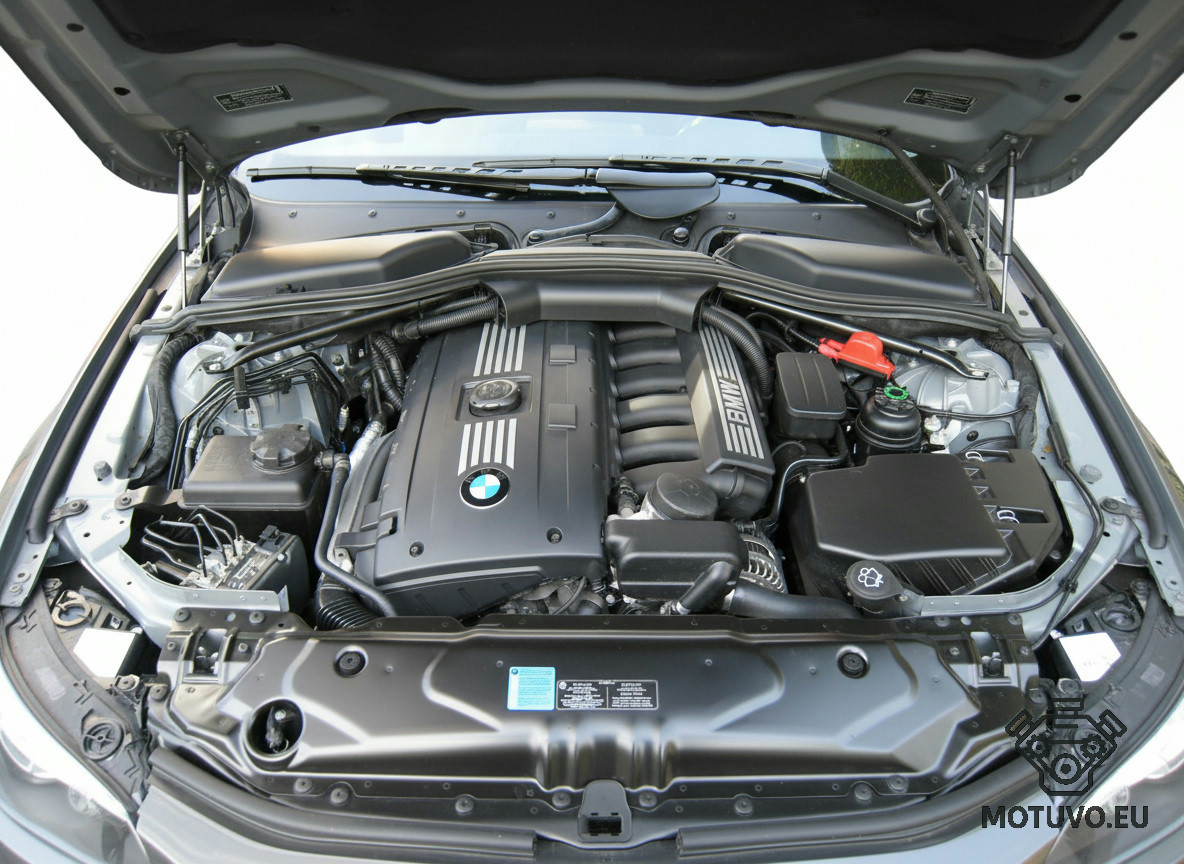
BMW N53B25A 2.5L 140 kW Engine: Specs and Replacement Guide
Introduction to the BMW N53B25A
The BMW N53B25A is a 2.5-litre petrol engine listed in the Motuvo.eu catalogue with an output of 140 kW, approximately 190 metric horsepower. The catalogue identifies its application as the BMW 5 Series, specifically the E60/E61 523i within a 2006–2010 listing range. For a replacement purchase, that description is a starting point rather than proof of compatibility with every 523i registered during those years.
Part of BMW’s N53 family, this naturally aspirated inline-six combines direct petrol injection with the smooth running characteristics associated with a six-cylinder layout. It offers progressive power delivery without a turbocharger, but its fuel injection and emissions systems require careful diagnosis. Understanding these systems is important when deciding whether to repair an existing engine or replace it.
How Popular and Widely Used Is This Engine?
The N53 family was an important part of BMW’s move towards direct-injection petrol engines in European-market cars. Its availability varied by market, partly because its lean-burn emissions strategy depended on suitable fuel quality and sulphur content. Consequently, an apparently similar BMW from another market may have a different engine family.
The N53B25A is more specific than the broader N53 name suggests: it identifies a particular 2.5-litre version, not every N53 engine. For this catalogue entry, the supported application is the E60/E61 523i. The longevity of these 5 Series cars creates continuing demand for replacement engines and specialist repairs, although no production totals or stock availability can be inferred from the catalogue.
Independent BMW specialists are generally familiar with N53 diagnostics. Nevertheless, familiarity with older port-injected BMW six-cylinder engines alone is not enough; direct injection and NOx-related faults require suitable diagnostic equipment and experience.
Other Part Numbers and Engine Variants
N53B25A is an engine designation, not a universal service part number for every compatible engine assembly. BMW replacement assembly numbers, component revisions and vehicle-specific equipment should be checked separately using the VIN and the identification of the proposed replacement.
The wider N53 family also includes 3.0-litre versions. Shared family architecture does not make those engines direct substitutes for this 2.5-litre unit. Displacement, management calibration, fuel-system specifications and peripheral equipment can differ.
The catalogue also lists the N52B25A, a 2.5-litre petrol engine rated at 160 kW, among related engines. It belongs to a different BMW engine family and should not be treated as an alternative code for the N53B25A. The N52 uses port injection and Valvetronic, whereas the N53 uses direct injection and does not retain the N52’s Valvetronic system.
Other related catalogue entries are BGDA, 4GR-FSE, EJ25, MA2.22 (DDNC) and 2AR. These are catalogue associations, not interchangeable replacements. Similar displacement or fuel type does not establish mechanical, electrical or emissions compatibility.
BMW N53B25A Model Applications
The supplied catalogue supports the following application:
- BMW 5 Series E60 523i: saloon, within the catalogue’s 2006–2010 listing.
- BMW 5 Series E61 523i: Touring, within the same catalogue listing.
Check the vehicle’s production date, original engine identification and market specification before ordering. The listing range should not be interpreted as confirmation that all E60/E61 523i cars built or registered between 2006 and 2010 use an N53B25A. BMW engine specifications changed during production, and registration year is not the same as build date.
A reliable compatibility assessment combines the VIN, engine designation and a comparison of the original and replacement assemblies. The 523i badge alone is insufficient.
Strong Points of the N53B25A
Smooth running and progressive response
The inline-six layout has inherently favourable primary and secondary balance. In good condition, the N53B25A provides smooth operation and linear acceleration suited to a 5 Series. Its naturally aspirated design also avoids turbocharger-specific repairs such as wastegate or boost-control faults.
Efficient combustion technology
Direct injection delivers fuel into the combustion chamber, allowing precise fuel metering. Under suitable operating conditions, the N53’s lean-burn strategy can reduce fuel consumption. Those benefits depend on functioning injectors, sensors and exhaust aftertreatment; they should not be assumed when emissions faults are present.
A serviceable specialist platform
Many running problems originate in replaceable supporting components rather than the engine’s main mechanical assembly. Accurate testing can therefore distinguish an injector, ignition or sensor problem from genuine internal wear, potentially avoiding an unnecessary complete-engine replacement.
Weak Points and Common Failures
Direct-injection injectors and fuel pressure
N53 piezoelectric injectors can develop leakage or poor spray behaviour, causing rough starts, misfires, fuel odour and uneven idle. Severe leakage can dilute the engine oil with petrol. Injector revision compatibility, correct seals and individual calibration data matter when fitting replacements.
The high-pressure fuel pump is another diagnostic consideration. Extended cranking, hesitation and fuel-pressure faults justify checking both the low-pressure supply and high-pressure system against BMW specifications. Symptoms alone cannot identify the failed component.
NOx sensor and emissions-system faults
The NOx sensor and NOx storage catalyst support the engine’s lean-burn operation. Faults can prevent efficient operating modes and increase consumption. Diagnosis should distinguish sensor failure from catalyst ageing, sulphur loading and other mixture-control problems rather than assuming one replacement part will solve everything.
Ignition faults and intake deposits
Worn spark plugs and failing ignition coils can cause misfires that resemble injector problems. Because direct injection does not wash the intake valves with petrol, intake deposits are also possible. Inspection is preferable to assuming that cleaning is needed on every engine.
Cooling-system and oil-leak concerns
The electric coolant pump and its control system deserve attention, alongside the thermostat, hoses and radiator. Overheating can turn a supporting-component failure into internal engine damage. Age-related oil leaks around the valve cover and oil-filter housing area should also be investigated, together with crankcase ventilation faults and abnormal oil consumption.
What to Consider When Replacing It
Establish why the original engine failed before installing another unit. A defective cooling system, leaking injector or unresolved lubrication problem may damage the replacement if transferred or left uncorrected.
- Confirm identity: match the N53B25A designation and verify vehicle compatibility through VIN-based parts information.
- Define the supply scope: ask whether injectors, fuel pump, manifolds, wiring, sensors and accessories are included. Do not assume that an engine is supplied ready to install.
- Request condition evidence: where available, review running-test results, compression or leak-down measurements, oil-pressure checks and documented mileage.
- Assess peripheral components: inspect cooling parts, mounts, seals and any accessories intended for reuse.
- Plan electronic setup: injector calibration entries and relevant adaptations may need attention. Retaining compatible original electronics is different from transferring a donor control unit.
- Review purchase terms: confirm warranty coverage, installation requirements and what documentation must be retained.
After installation, follow the appropriate lubrication priming and electric cooling-system bleeding procedures. Verify fuel pressure, cooling performance, leak-free operation and smooth running, then perform a diagnostic scan and controlled road test.
Buy a BMW N53B25A Engine at Motuvo.eu
If your 523i needs a replacement engine, explore the BMW N53B25A 140 kW engine at Motuvo.eu. Provide your VIN and existing engine details before buying, and confirm the available unit’s condition, included components and warranty terms. Careful matching helps you choose the right engine and avoid unnecessary installation complications.