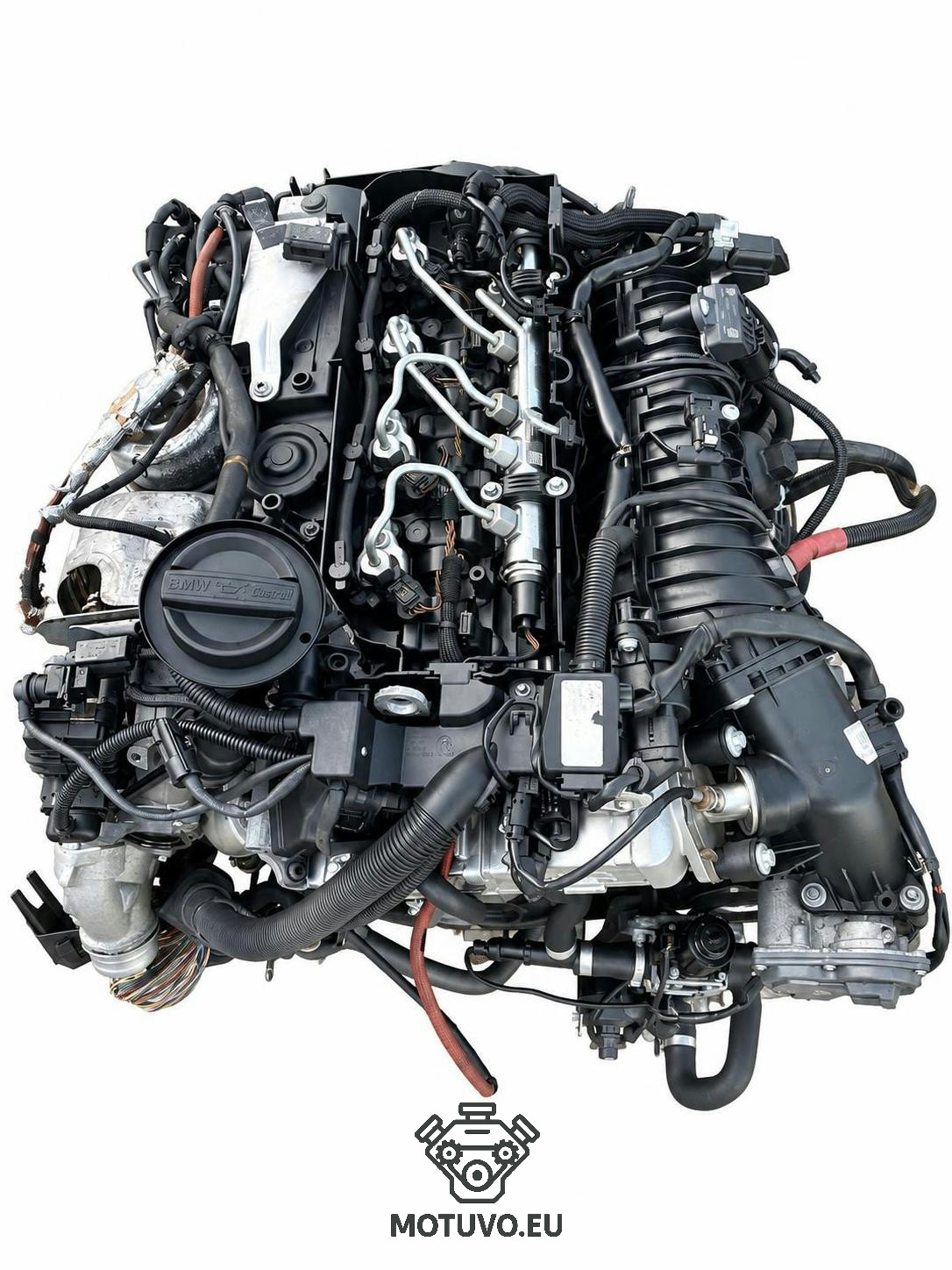
BMW N47D20D Engine Guide – 150 kW vs 160 kW Versions, E-Series vs F-Series, Differences, Problems and Replacement Engines
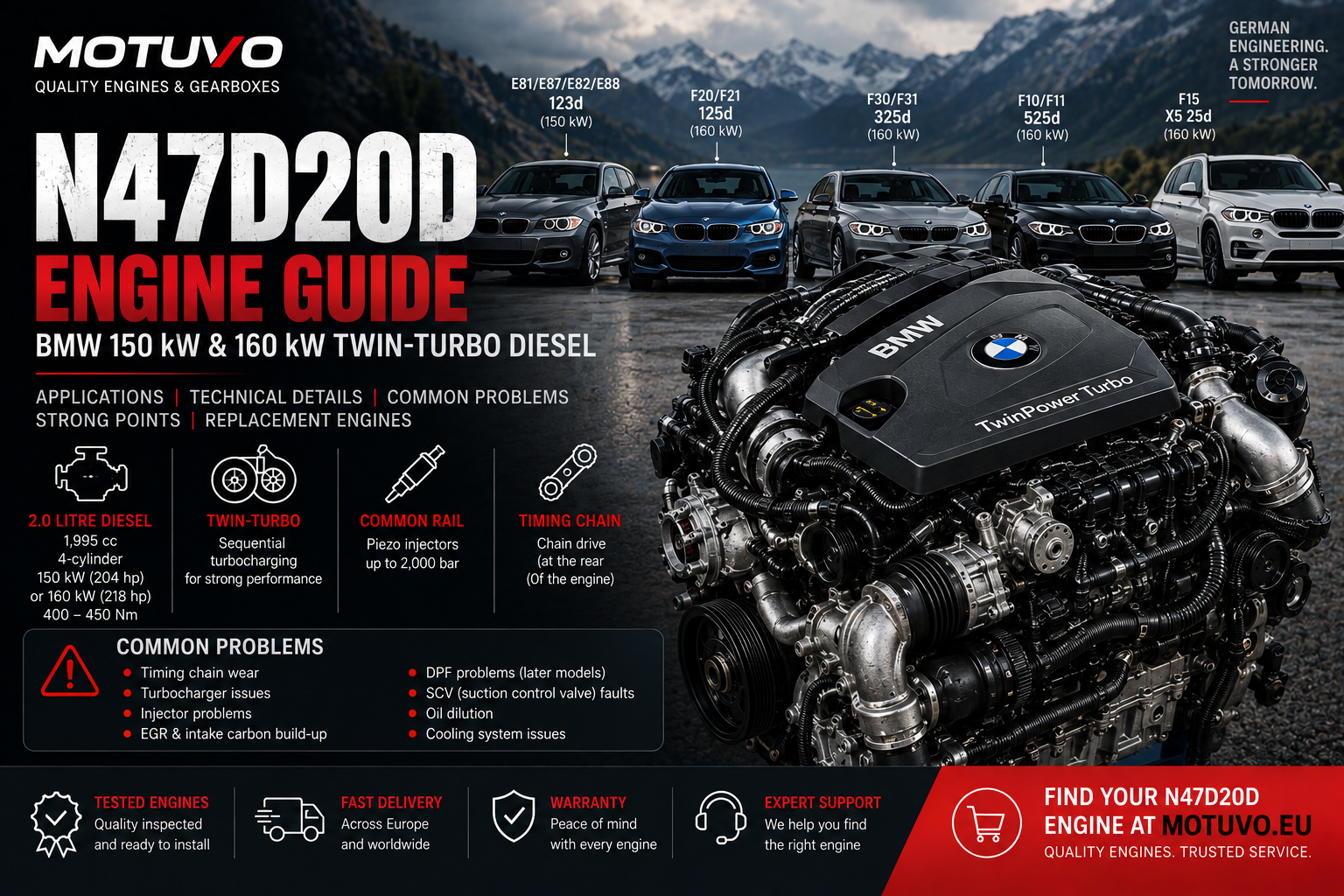
BMW N47D20D Engine Guide – 150 kW vs 160 kW Versions, E-Series vs F-Series, Differences, Problems and Replacement Engines
The BMW N47D20D is the highest-performance twin-turbo version of BMW's well-known N47 2.0-litre four-cylinder diesel family.
It is particularly interesting in the replacement-engine market because the same commonly used N47D20D description is applied to two significantly different generations:
- N47D20T0 – 150 kW / 204 hp / 400 Nm
- N47D20T1 – 160 kW / 218 hp / 450 Nm
The earlier 150 kW engine is most strongly associated with BMW E-series models such as the 123d and X1 xDrive23d. The later 160 kW version was introduced with the newer F-series generation and appears in the 125d, 225d, 325d, 425d, 525d and X5 25d.
These engines belong to the same N47 family, share the same 1,995 cc displacement and both use sequential two-stage turbocharging, but they should not be treated as interchangeable complete engines.
The difference is not simply 14 horsepower.
BMW revised the engine generation, turbocharging control, fuel and emissions systems, electronics and vehicle-specific installation components.
This guide explains the 150 kW and 160 kW N47D20D versions, their model applications, technical differences, xDrive considerations, common problems, strong points and what to check before purchasing a replacement engine.
BMW N47D20D Basic Specifications
| Manufacturer | BMW |
|---|---|
| Engine family | N47 |
| Common replacement-engine designation | N47D20D |
| BMW technical versions | N47D20T0 and N47D20T1 |
| Fuel | Diesel |
| Configuration | Inline four-cylinder |
| Displacement | 1,995 cc |
| Bore | 84 mm |
| Stroke | 90 mm |
| Valves | 16 |
| Cylinder block | Aluminium alloy |
| Fuel system | Common-rail direct injection |
| Injector type | Piezoelectric injectors |
| Maximum injection pressure | Up to approximately 2,000 bar |
| Turbocharging | Two-stage / sequential twin turbo |
| Timing system | Timing chain |
| Timing-chain location | Rear of engine, gearbox side |
| Installation | Longitudinal |
The Two Main N47D20D Versions
| Technical version | Power | Torque | Main generation |
|---|---|---|---|
| N47D20T0 | 150 kW / 204 hp | 400 Nm | Mainly BMW E-series |
| N47D20T1 | 160 kW / 218 hp | 450 Nm | Mainly BMW F-series |
Although sellers frequently advertise both simply as N47D20D, BMW's internal technical designation clearly separates the earlier T0 and later T1 engine generations.
N47D20T0 – 150 kW / 204 hp
The original high-output N47 appeared in the BMW 123d in 2007.
BMW described it as the first production all-aluminium diesel engine to exceed 100 hp per litre of displacement.
Technical specification:
- 1,995 cc
- 150 kW / 204 hp at approximately 4,400 rpm
- 400 Nm at approximately 2,000–2,250 rpm
- Compression ratio around 16.5:1
- Two sequential turbochargers
- Common rail with piezo injectors
- Approximately 2,000-bar maximum injection pressure
The combination of a small and a large turbocharger gave the 123d unusually strong performance for a 2.0-litre diesel.
150 kW N47D20T0 Model Applications
BMW 123d – E81 / E82 / E87 / E88
The best-known application is the BMW 123d.
It was available as:
- BMW E81 123d three-door
- BMW E87 123d five-door
- BMW E82 123d Coupé
- BMW E88 123d Convertible
Typical specification:
- 150 kW / 204 hp
- 400 Nm
- Rear-wheel drive
- Six-speed manual or automatic depending on model and market
BMW X1 xDrive23d – E84
The other important application is the early BMW X1 xDrive23d.
Typical specification:
- E84 X1
- xDrive all-wheel drive
- 150 kW / 204 hp
- 400 Nm
- N47D20T0
The X1 version requires additional attention when buying a replacement engine because the xDrive installation affects components around the sump, drivetrain and mounting system.
N47D20T1 – 160 kW / 218 hp
BMW introduced a substantially updated version of the twin-turbo N47 during the transition to the F-series generation.
BMW's technical designation for this engine is N47D20T1.
Typical specification:
- 1,995 cc
- 160 kW / 218 hp
- 450 Nm between approximately 1,500 and 2,500 rpm
- Two-stage turbocharging
- Smaller high-pressure turbo with variable turbine geometry
- Common-rail direct injection
- Piezo injectors
- Injection pressure up to approximately 2,000 bar
Compared with the previous 204 hp engine, output increased by:
- 10 kW
- 14 hp
- 50 Nm
More importantly, BMW revised the engine as part of the later N47 technical generation rather than simply changing the software.
160 kW N47D20T1 Applications
BMW 125d – F20 / F21
The 125d replaced the E-series 123d as BMW's high-performance four-cylinder diesel 1 Series.
- BMW F20 125d
- BMW F21 125d
- 160 kW / 218 hp
- 450 Nm
BMW 225d – F22
The first-generation 2 Series Coupé also used the 218 hp engine.
- BMW F22 225d
- 160 kW / 218 hp
- Two-stage turbocharging
BMW 325d – F30 / F31 / F34
Applications include:
- F30 325d Sedan
- F31 325d Touring
- F34 325d Gran Turismo
All use the high-output 2.0-litre twin-turbo diesel rather than the six-cylinder diesel found under some older BMW model badges.
BMW 425d – F32 / F33 / F36
The same engine generation also appears in the 4 Series:
- F32 425d Coupé
- F33 425d Convertible
- F36 425d Gran Coupé in applicable production periods
BMW 525d – F10 / F11
One of the most interesting applications is the F10/F11 525d.
Earlier generations of the 525d badge were associated with six-cylinder engines, but BMW switched the F10/F11 525d to the high-output four-cylinder N47.
Applications include:
- BMW F10 525d Sedan
- BMW F11 525d Touring
- BMW F10 525d xDrive
- BMW F11 525d xDrive
Typical output:
- 160 kW / 218 hp
- 450 Nm
BMW X5 25d – F15
The N47D20T1 was powerful enough that BMW also fitted it to the third-generation X5.
Applications include:
- F15 X5 sDrive25d
- F15 X5 xDrive25d
These engines still produce approximately 160 kW / 218 hp but use SUV-specific installation hardware.
The Important Exception – E84 X1 xDrive25d 160 kW
It is convenient to describe the N47D20D family as:
- 150 kW = E-series
- 160 kW = F-series
But there is one important exception.
The facelifted BMW X1 E84 xDrive25d uses the later:
- N47D20T1
- 160 kW / 218 hp
- 450 Nm
The earlier E84 X1 xDrive23d used the 150 kW N47D20T0, while the facelift xDrive25d moved to the later 160 kW engine.
This is an excellent example of why chassis generation alone is not enough to identify a replacement engine.
150 kW vs 160 kW N47D20D – Technical Comparison
| Feature | 150 kW N47D20T0 | 160 kW N47D20T1 |
|---|---|---|
| Displacement | 1,995 cc | 1,995 cc |
| Configuration | Inline 4 diesel | Inline 4 diesel |
| Output | 150 kW / 204 hp | 160 kW / 218 hp |
| Torque | 400 Nm | 450 Nm |
| BMW technical code | N47D20T0 | N47D20T1 |
| Turbocharging | Two-stage Variable Twin Turbo | Revised two-stage turbo system |
| Fuel injection | Common rail, piezo | Common rail, piezo |
| Maximum injection pressure | Approximately 2,000 bar | Approximately 2,000 bar |
| Typical vehicle generation | E-series | F-series |
| Typical torque peak | 400 Nm around 2,000–2,250 rpm | 450 Nm around 1,500–2,500 rpm |
| Complete-engine interchange | No – do not treat as interchangeable | |
Why the 150 kW and 160 kW Engines Are Not Interchangeable
This is the most important point for replacement-engine buyers.
A seller may advertise both engines as N47D20D, but the earlier N47D20T0 and later N47D20T1 should not be treated as the same complete engine.
Potential differences include:
- Engine-generation revision
- Turbocharger assemblies
- Turbocharger control system
- Intake and charge-air components
- Exhaust manifolds
- EGR configuration
- DPF and emissions equipment
- Fuel-system components and calibration
- Engine sensors
- Engine wiring harness
- DDE engine-management calibration
- Cooling pipes
- Accessory brackets
- Oil sump
- Flywheel or flexplate
- Transmission-specific equipment
Even where some internal components or the basic cylinder-block architecture are related, that does not make a 150 kW T0 engine a plug-and-play replacement for a 160 kW T1 vehicle.
xDrive Makes Compatibility Even More Important
BMW used both engines in rear-wheel-drive and all-wheel-drive applications.
xDrive vehicles can use different:
- Oil sump configurations
- Oil pickup arrangements
- Mounting brackets
- Front differential clearance
- Transmission equipment
- Accessory arrangements
Examples include:
- E84 X1 xDrive23d – 150 kW
- E84 X1 xDrive25d – 160 kW
- F10/F11 525d xDrive – 160 kW
- F15 X5 xDrive25d – 160 kW
An engine from a rear-wheel-drive 125d or 325d should therefore not automatically be sold as a complete direct replacement for an xDrive vehicle.
Can a 150 kW N47D20D Replace a 160 kW Version?
Not as a direct complete-engine replacement.
The earlier 150 kW N47D20T0 and later 160 kW N47D20T1 are different technical generations.
Installing a T0 engine into a vehicle originally equipped with a T1 can create compatibility problems involving:
- Turbocharging
- Electronics
- Engine management
- Fuel system
- Emissions equipment
- Ancillary components
A specialist may sometimes identify individual compatible internal components, but this is different from saying that the complete engines are interchangeable.
Can a 160 kW N47D20D Replace the 150 kW Version?
The same rule applies in reverse.
A later 218 hp T1 engine should not be treated as a simple upgrade for a 204 hp T0 vehicle.
Such a conversion can require:
- DDE changes
- Turbo-system changes
- Wiring changes
- Fuel-system adaptation
- Exhaust and emissions changes
- Vehicle coding
For a repair intended to return the car to factory specification, sourcing the correct engine generation is the better solution.
Can a 123d Engine Fit a 125d?
This is one of the most common N47D20D replacement questions.
The answer is not as a straightforward complete-engine swap.
The:
- E8x 123d uses N47D20T0, 150 kW
- F20/F21 125d uses N47D20T1, 160 kW
The correct solution is to source an N47D20T1 for the 125d rather than purchasing an older 123d engine simply because both are advertised as N47D20D.
Can a 125d Engine Fit a 325d?
This is much more realistic because both can use the 160 kW N47D20T1.
However, complete interchangeability still depends on:
- Production date
- Manual or automatic transmission
- Engine brackets
- Oil sump
- Intake and exhaust equipment
- Wiring
- Emissions specification
A 125d long block may be a strong donor candidate for a 325d, but the VIN and OEM component numbers should be compared.
Can a 325d Engine Fit a 525d?
Potentially, because both may use the N47D20T1 160 kW engine.
But the F10/F11 installation can use different:
- Sump
- Mounting brackets
- Cooling components
- Ancillaries
- Transmission hardware
A compatible long block may work after transferring original 525d equipment.
Can a 525d Engine Fit an X5 25d?
Again, the basic N47D20T1 may be related, but the F15 X5 installation is significantly different.
Vehicle-specific components can include:
- Oil sump
- Engine mounts
- Cooling equipment
- Intake system
- Exhaust system
- xDrive equipment
- Accessory brackets
For an X5, a correctly matched X5 donor is preferable whenever possible.
The Biggest N47D20D Weak Point – Timing Chain
The best-known weakness of the entire N47 family is the timing-chain system.
Unlike many engines where the timing system is positioned at the front, the N47 timing chains are positioned at the rear of the engine next to the gearbox.
This makes replacement labour intensive.
Possible Symptoms
- Metallic rattle during cold start
- Scraping or rattling from the rear of the engine
- Chain noise at idle
- Noise around 1,500–2,000 rpm
- Camshaft/crankshaft correlation faults
- Extended cranking
- Poor running
If a chain jumps or breaks, severe internal engine damage can result.
Possible damage includes:
- Bent valves
- Broken rocker components
- Damaged pistons
- Cylinder-head damage
- Camshaft damage
Are the Later 160 kW Timing Chains Better?
BMW revised the N47 timing system repeatedly during production.
The later N47D20T1 belongs to a newer N47 technical generation than the earliest 204 hp engines.
This generally makes later examples more desirable than the earliest N47 units, but it does not mean timing-chain wear is impossible.
Condition still depends heavily on:
- Oil-change intervals
- Correct oil specification
- Mileage
- Cold-start operation
- Previous chain repairs
A replacement engine with documented timing-chain work is usually worth significantly more than one with no history.
2. Twin-Turbo System Problems
Unlike the more common N47D20C engines used in 18d and 20d applications, the N47D20D high-output versions use two turbochargers.
The smaller turbo provides rapid boost at low engine speed while the larger turbo supplies the airflow required at higher loads.
Possible problems include:
- Small turbocharger bearing wear
- Large turbocharger wear
- Variable-geometry mechanism sticking
- Turbo-control valve faults
- Vacuum-control problems
- Actuator problems
- Oil-feed restrictions
- Boost leaks
Symptoms include:
- Poor low-rpm response
- Loss of high-rpm power
- Underboost faults
- Overboost faults
- Whistling
- Blue smoke
- Black smoke
- Limp-home mode
The two-stage system provides excellent performance but is considerably more expensive to repair than a conventional single-turbo N47.
3. Piezo Injector Problems
Both high-output versions use sophisticated common-rail injection with piezoelectric injectors.
Possible symptoms of injector wear include:
- Difficult starting
- Uneven idle
- Diesel knock
- White or grey smoke
- Excessive correction values
- High fuel consumption
- DPF regeneration problems
A severely leaking injector can also dilute engine oil with diesel or damage a piston.
4. DPF Problems
Both generations use diesel particulate filtration in European applications.
Problems are most common when the vehicle is used primarily for:
- Short trips
- Urban driving
- Frequent cold starts
- Interrupted regeneration cycles
Symptoms include:
- Frequent regeneration
- DPF warning
- Reduced engine power
- Higher fuel consumption
- Cooling fan running after shutdown
- Rising oil level
A blocked DPF can also increase exhaust backpressure and contribute to turbocharger damage.
5. EGR and Intake Carbon Build-Up
EGR soot combines with oil vapour from the crankcase ventilation system.
Deposits can accumulate in:
- EGR valve
- Intake manifold
- Intake ports
- Air-control components
- MAP sensor
Symptoms include:
- Poor throttle response
- Reduced power
- Black smoke
- Uneven acceleration
- EGR faults
6. Intake Swirl-System Problems
High-mileage N47 engines can develop problems with the intake-manifold swirl-control system.
Possible problems include:
- Carbon contamination
- Actuator faults
- Linkage wear
- Air leaks around the mechanism
The complete intake system should be inspected if airflow faults persist.
7. Thermostat Problems
N47 thermostats can become weak and remain partially open.
The engine then runs below its intended temperature.
This can contribute to:
- Poor fuel economy
- Weak cabin heating
- Incomplete DPF regeneration
- Increased soot accumulation
Actual coolant temperature should be checked diagnostically on vehicles suffering repeated DPF problems.
8. Crankcase-Ventilation Problems
A defective crankcase breather may result in:
- Excessive crankcase pressure
- Oil consumption
- Turbocharger oil leakage
- Oil leaks
- Oil accumulation inside charge pipes
Crankcase pressure should be checked before replacing turbochargers.
9. Oil Leaks
With age and mileage, leaks may develop around:
- Rocker cover
- Oil-filter housing
- Timing covers
- Oil sump
- Crankshaft seals
- Turbo oil lines
Because the timing system and turbochargers rely heavily on correct lubrication, oil loss should not be ignored.
10. Glow Plugs and Glow-Plug Controller
Glow-system faults are common on ageing N47 engines.
Symptoms include:
- Difficult cold starting
- Rough running immediately after startup
- Glow-plug fault codes
- Poor cold-weather operation
- DPF regeneration difficulties
11. Dual-Mass Flywheel and Clutch Wear
The 400–450 Nm output places significant load on manual-transmission clutch and dual-mass flywheel components.
Possible symptoms include:
- Rattling at idle
- Clutch judder
- Vibration
- Noise when switching the engine off
- Clutch slip under heavy acceleration
These noises can sometimes be mistaken for timing-chain problems, so careful diagnosis is required.
Strong Points of the N47D20D
Exceptional Power for a 2.0 Diesel
The original 204 hp engine was remarkable for its time and exceeded 100 hp per litre.
The later 218 hp version moved the concept even further.
Very Strong Torque
The later version produces approximately 450 Nm from only 2.0 litres.
This makes it particularly effective in:
- 1 Series
- 2 Series
- 3 Series
- 5 Series
- X1
Excellent Real-World Performance
Two-stage turbocharging gives strong response at low rpm while retaining excellent power at higher engine speeds.
The result is much broader performance than a typical single-turbo four-cylinder diesel.
Good Fuel Efficiency
Despite outputs above 200 hp, these engines can offer fuel consumption similar to substantially less powerful diesels when driven normally.
Large European Parts Market
The N47 family was produced in large numbers, giving good availability of:
- Used engines
- Rebuilt engines
- Timing-chain kits
- Turbochargers
- Injectors
- Internal components
Why the N47D20D Is Popular
The engine occupies a unique position in BMW history.
The E-series 123d demonstrated that a 2.0-litre four-cylinder diesel could provide performance previously associated with much larger engines.
The later N47D20T1 extended the idea into:
- 125d
- 225d
- 325d
- 425d
- 525d
- X1 25d
- X5 25d
This wide application range creates strong demand for replacement N47D20D engines across Europe.
It is especially popular with customers looking for:
- High diesel performance
- Lower fuel consumption than six-cylinder engines
- Strong motorway torque
- Good tuning potential
What to Check Before Buying a Used N47D20D
Before ordering a replacement engine, request:
- Complete engine code
- BMW technical designation – T0 or T1
- Power output in kW
- Donor VIN
- Donor model
- Production date
- Rear-wheel drive or xDrive
- Manual or automatic transmission
- Recorded mileage
- Service history
- Cold-start video
- Timing-chain history
- Oil-pressure information
- Compression-test results
- Injector correction values
- Turbocharger condition
- DPF condition
- EGR history
- Warranty terms
For this engine family, the two most important questions are:
- Is it 150 kW N47D20T0 or 160 kW N47D20T1?
- Does the donor drivetrain and vehicle generation match the original car?
What to Check Before Installing a Replacement N47D20D
With the engine removed from the vehicle, several expensive jobs become easier.
Consider inspecting or replacing:
- Timing chains
- Chain guides
- Chain tensioners
- Rear crankshaft seal
- Accessory belt
- Belt tensioner
- Engine mounts
- Turbocharger oil-feed lines
- Engine oil and filter
- Fuel filter
The vehicle's DPF, intercooler and charge-air system should also be checked before starting the replacement engine.
If the original engine failed because of a turbocharger, injector or lubrication fault, the cause must be corrected before installation.
Used, Rebuilt or Remanufactured N47D20D?
Used N47D20D Engine
Advantages:
- Lower purchase cost
- Original BMW components
- Good European availability
- Fast replacement when correctly matched
Disadvantages:
- Unknown timing-chain condition
- Unknown turbocharger condition
- Potential injector wear
- Possible previous DPF problems
- T0 and T1 versions are frequently confused by sellers
Rebuilt N47D20D
A proper rebuild may include:
- Main bearings
- Connecting-rod bearings
- Piston rings
- Pistons where required
- Cylinder inspection
- Cylinder-head overhaul
- New timing chains
- New guides and tensioners
- Oil-pump inspection
- Injector testing
- Both turbochargers inspected
Remanufactured N47D20D
A professionally remanufactured engine should be rebuilt according to measured tolerances.
Typical work can include:
- Complete disassembly
- Crack testing
- Crankshaft measurement
- Cylinder measurement
- New bearings
- New piston rings
- Reconditioned cylinder head
- New timing-chain components
- Oil-pressure testing
- Compression testing
- Warranty
N47D20D Maintenance Recommendations
- Change engine oil more frequently than the longest factory interval
- Use the correct BMW-approved low-ash oil
- Never ignore timing-chain noise
- Monitor both turbochargers for oil or boost problems
- Replace the fuel filter regularly
- Monitor injector correction values
- Allow DPF regeneration to complete
- Keep the EGR and intake system clean
- Check coolant operating temperature
- Inspect crankcase ventilation
- Investigate increasing engine-oil level
- Do not ignore low oil pressure
- Check turbo oil supply after any turbocharger failure
Frequently Asked Questions About N47D20D
What is the N47D20D?
It is the high-output twin-turbo 2.0-litre version of BMW's N47 four-cylinder diesel family.
Are there two N47D20D versions?
Yes. The two important performance generations are:
- N47D20T0 – 150 kW / 204 hp / 400 Nm
- N47D20T1 – 160 kW / 218 hp / 450 Nm
Which BMWs use the 150 kW engine?
Important applications include:
- BMW 123d E81
- BMW 123d E82
- BMW 123d E87
- BMW 123d E88
- BMW X1 E84 xDrive23d
Which BMWs use the 160 kW engine?
Important applications include:
- BMW 125d F20/F21
- BMW 225d F22
- BMW 325d F30/F31/F34
- BMW 425d F32/F33/F36
- BMW 525d F10/F11
- BMW 525d xDrive F10/F11
- BMW X5 25d F15
- BMW X1 E84 xDrive25d
Is every E-series N47D20D 150 kW?
No. The important exception is the facelift E84 X1 xDrive25d, which uses the later 160 kW N47D20T1.
Are the 150 kW and 160 kW engines interchangeable?
They should not be treated as interchangeable complete engines. The 150 kW N47D20T0 and 160 kW N47D20T1 represent different technical generations with differences in engine control, turbo system and vehicle-specific equipment.
Does N47D20D have one or two turbochargers?
Two. Both the 204 hp and 218 hp high-output versions use two-stage turbocharging.
Does N47D20D use a timing belt?
No. It uses timing chains mounted at the gearbox side of the engine.
What is the biggest N47D20D problem?
Timing-chain wear is the best-known major weakness. The twin-turbo system, piezo injectors, EGR and DPF are also important areas to check.
Is the 218 hp version better than the 204 hp version?
It is a later and more powerful technical revision, producing an additional 50 Nm of torque. Later engines also benefited from BMW's ongoing N47 revisions, but they still require careful timing-chain and turbocharger maintenance.
Can a 125d engine fit a 325d?
Potentially as a matching N47D20T1 long block, but the production date and vehicle-specific sump, mounts, wiring, transmission and external components must be checked.
Can a 123d engine fit a 125d?
Not as a normal direct replacement. The 123d uses the earlier N47D20T0 150 kW generation, while the 125d uses N47D20T1 160 kW.
Is N47D20D reliable?
It can be very durable and exceptionally capable when maintained correctly. Its reliability depends heavily on timing-chain condition, regular oil changes, turbocharger lubrication, injector health and proper DPF operation.
Find the Correct BMW N47D20D Replacement Engine at MOTUVO
If your BMW requires a replacement N47D20D engine, matching the shortened engine code alone is not enough.
There are two particularly important versions:
- N47D20T0 – 150 kW / 204 hp / 400 Nm
- N47D20T1 – 160 kW / 218 hp / 450 Nm
These engines should not be treated as interchangeable.
MOTUVO can help identify replacement engines for:
- BMW 123d E81 / E82 / E87 / E88
- BMW X1 xDrive23d E84
- BMW X1 xDrive25d E84
- BMW 125d F20 / F21
- BMW 225d F22
- BMW 325d F30 / F31 / F34
- BMW 425d F32 / F33 / F36
- BMW 525d F10 / F11
- BMW 525d xDrive F10 / F11
- BMW X5 sDrive25d / xDrive25d F15
Choosing a replacement simply because it is advertised as “N47D20D” or “BMW 2.0 twin-turbo diesel” can result in buying the wrong engine generation.
MOTUVO checks compatibility using:
- Vehicle VIN
- N47D20D engine designation
- N47D20T0 or N47D20T1 technical version
- 150 kW or 160 kW output
- Engine serial number
- Production date
- Vehicle chassis
- Rear-wheel drive or xDrive
- Manual or automatic transmission
- Turbocharger specification
- Original emissions and ancillary equipment
MOTUVO can help source:
- Tested used N47D20D engines
- Rebuilt N47D20D engines
- Remanufactured N47D20D engines
- Bare engines
- Long blocks
- Complete engines with selected accessories
Send MOTUVO your VIN, production year, model and original engine number and we can identify whether your BMW requires the 150 kW N47D20T0 or the 160 kW N47D20T1 before you order.
Find the correct BMW N47D20D replacement engine at MOTUVO.EU.