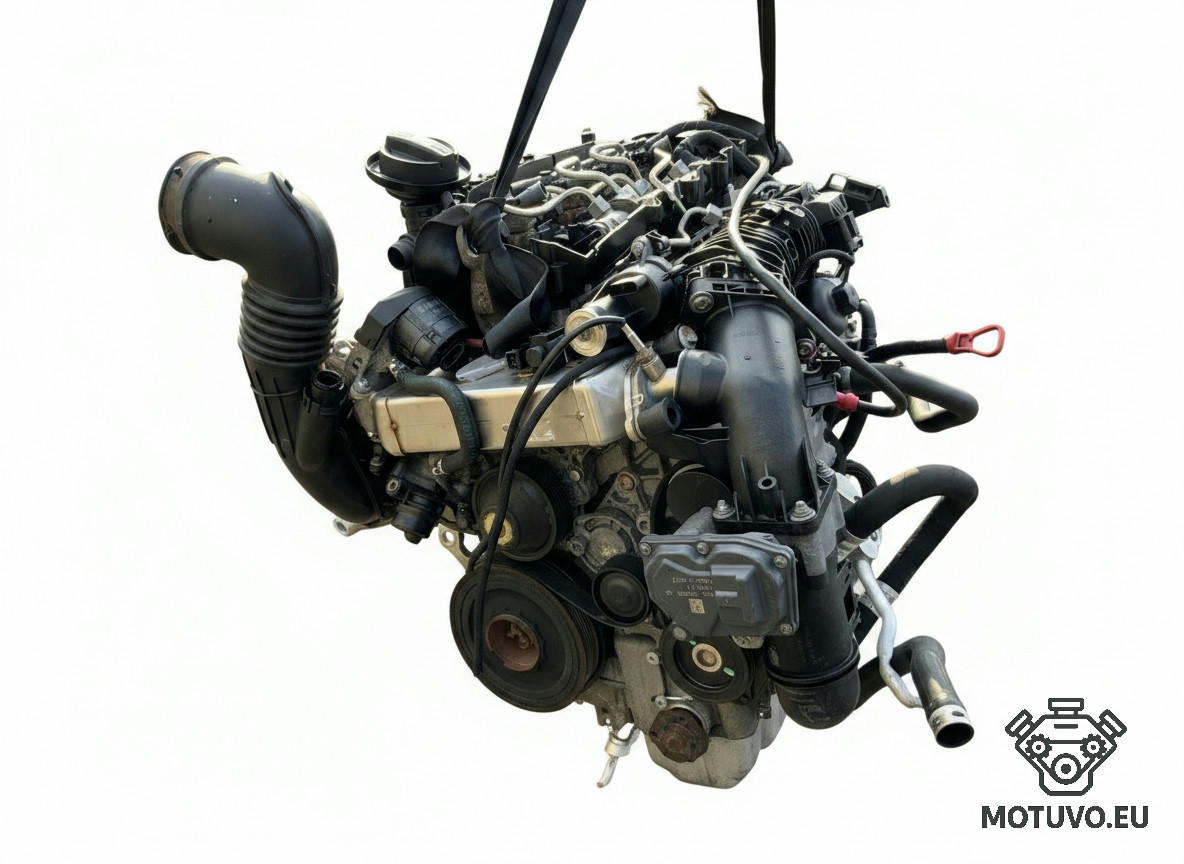
BMW N47D20C Engine Guide – E-Series vs F-Series Versions, xDrive Differences, Common Problems and Replacement Engines
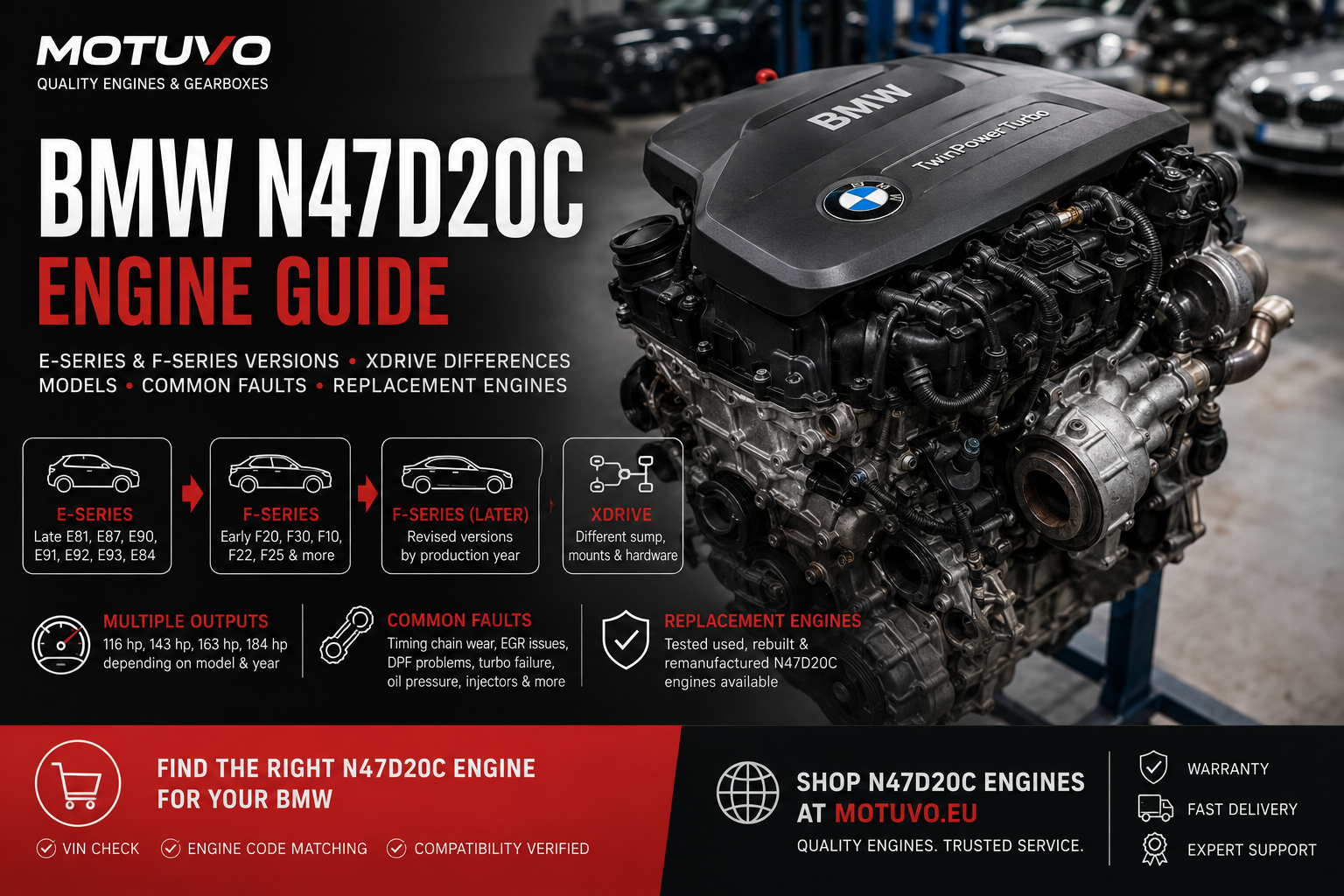
BMW N47D20C Engine Guide – E-Series vs F-Series Versions, xDrive Differences, Common Problems and Replacement Engines
The BMW N47D20C is one of the most widely used versions of BMW's N47 2.0-litre four-cylinder diesel engine. It can be found in late E-series BMWs and throughout a large part of the early F-series range, including the 1 Series, 2 Series, 3 Series, 4 Series, 5 Series, X1 and X3.
At first glance, identifying a replacement seems simple: the original engine says N47D20C, so another N47D20C should fit.
In practice, it is considerably more complicated.
BMW continued using the same N47D20C family designation while revising the engine and adapting it to different vehicle generations, production years, power outputs and drivetrains. As a result, there are several physically different N47D20C configurations in the replacement-engine market.
The most important distinction for buyers is between:
- Late E-series N47D20C engines
- Early F-series N47D20C engines
- Later revised F-series N47D20C engines
- Rear-wheel-drive and xDrive configurations
Two engines can therefore both carry the N47D20C designation while differences in the sump, mounts, timing components, ancillary equipment, turbocharger, fuel system or emissions hardware prevent a straightforward plug-and-play installation.
This guide explains the different N47D20C versions, BMW model applications, xDrive differences, common failures, interchangeability and how to choose the correct replacement engine.
BMW N47D20C Specifications
| Manufacturer | BMW |
|---|---|
| Engine family | N47 |
| Engine code | N47D20C |
| Fuel type | Diesel |
| Configuration | Inline four-cylinder |
| Displacement | 1,995 cc |
| Bore | 84 mm |
| Stroke | 90 mm |
| Fuel system | Common-rail direct injection |
| Aspiration | Turbocharged |
| Valve train | DOHC, 16 valves |
| Timing system | Timing chain |
| Timing-chain position | Rear of the engine, gearbox side |
| Installation | Longitudinal |
| Drive configurations | Rear-wheel drive and xDrive |
| Common power outputs | 116 hp, 136 hp, 143 hp, 163 hp and 184 hp depending on model |
| High-volume version | 135 kW / 184 hp, approximately 380 Nm |
| Successor | BMW B47 diesel family |
The most familiar N47D20C version is the 135 kW / 184 hp engine used in cars such as the BMW 120d, 320d and 520d.
However, the N47D20C designation also appears on lower-output variants. This is why horsepower alone cannot be used to identify the correct replacement engine.
Why One N47D20C Code Can Mean Several Different Engines
BMW engine codes identify an engine family and technical configuration, but they do not necessarily describe every production revision or every vehicle-specific external component.
During the lifespan of the N47D20C, BMW changed:
- Timing-chain components
- Chain guides and tensioners
- Oil-feed details
- Fuel-system components
- Injectors
- Turbocharger and actuator specifications
- Intake and EGR equipment
- Emission-control hardware
- Oil sump and oil pickup
- Engine brackets
- Wiring and sensors
This creates a situation frequently encountered by dismantlers and workshops:
the engine code matches, but the engine itself is not identical.
For replacement purposes, N47D20C engines are therefore best separated into three broad groups.
Version 1: N47D20C in Late E-Series BMW Models
The first important N47D20C configuration is the version found in late E-series BMWs.
It became particularly common after the 2010 technical revisions and was installed in vehicles such as:
- BMW E81 / E82 / E87 / E88 1 Series
- BMW E90 3 Series Saloon
- BMW E91 3 Series Touring
- BMW E92 3 Series Coupé
- BMW E93 3 Series Convertible
- BMW E84 X1
Typical E-Series N47D20C Applications
| BMW model | Chassis | Typical version | Typical output |
|---|---|---|---|
| 116d | E81 / E87 | 2.0 diesel | 116 hp in selected versions |
| 118d | E81 / E82 / E87 / E88 | 2.0 diesel | 143 hp |
| 120d | E81 / E82 / E87 / E88 | 2.0 diesel | 184 hp on later versions |
| 316d | E90 / E91 | 2.0 diesel | 116 hp |
| 318d | E90 / E91 | 2.0 diesel | 143 hp |
| 320d EfficientDynamics | E90 / E91 | 2.0 diesel | 163 hp |
| 320d | E90 / E91 / E92 / E93 | 2.0 diesel | 184 hp |
| X1 18d | E84 | sDrive / xDrive depending on version | 143 hp |
| X1 20d | E84 | sDrive / xDrive | 177 or 184 hp depending on year |
The E90 320d EfficientDynamics is particularly interesting because it uses an N47D20C rated at approximately 120 kW / 163 hp, whereas the conventional later 320d commonly produces 135 kW / 184 hp.
Both can carry the N47D20C designation.
Version 2: Early F-Series N47D20C
BMW continued using the N47D20C when the F-series generation arrived.
Early F-series vehicles retained the basic N47 architecture but use different vehicle packaging and various revised external components compared with the late E-series engine.
Typical applications include:
- F20 / F21 1 Series
- F30 / F31 3 Series
- F10 / F11 5 Series
- F07 5 Series Gran Turismo
- F25 X3
The common 184 hp version produces approximately:
- 135 kW
- 184 hp
- 380 Nm
Although an E-series and an early F-series engine may both say N47D20C, the safest approach is not to regard them as identical complete assemblies.
Possible differences include:
- Engine-mount brackets
- Oil sump
- Intake system
- EGR configuration
- Turbocharger actuator
- Cooling pipes
- Wiring harness
- Flywheel or flexplate
- Ancillary brackets
Version 3: Later Revised F-Series N47D20C
The N47D20C remained in production during the F-series period before BMW gradually replaced it with the B47.
During this period BMW continued making technical revisions, meaning that an early F-series N47D20C and a late F-series N47D20C should not automatically be treated as identical.
Later F-series versions can differ in areas such as:
- Timing-chain revision
- Chain tensioner
- Guide design
- Oil lubrication revisions
- Injector part numbers
- Fuel rail and high-pressure system
- EGR system
- Emissions equipment
- Sensors and wiring
- Turbocharger specification
This production-date split is particularly important when purchasing a bare or long-block replacement engine.
Common F-Series N47D20C Applications
| Series | Chassis | Common model | Typical output |
|---|---|---|---|
| 1 Series | F20 / F21 | 116d | 116 hp |
| 1 Series | F20 / F21 | 118d | 143 hp |
| 1 Series | F20 / F21 | 120d | 184 hp |
| 1 Series | F20 / F21 | 120d xDrive | 184 hp |
| 2 Series | F22 | 218d | 143 hp |
| 2 Series | F22 | 220d | 184 hp |
| 3 Series | F30 / F31 | 316d | 116 hp |
| 3 Series | F30 / F31 | 318d | 143 hp |
| 3 Series | F30 / F31 | 320d EfficientDynamics | 163 hp |
| 3 Series | F30 / F31 | 320d | 184 hp |
| 3 Series | F30 / F31 | 320d xDrive | 184 hp |
| 3 Series GT | F34 | 320d | 184 hp |
| 4 Series | F32 / F33 / F36 | 420d | 184 hp |
| 4 Series | F32 / F36 | 420d xDrive | 184 hp |
| 5 Series | F10 / F11 | 518d | 143 hp |
| 5 Series | F10 / F11 | 520d | 184 hp |
| 5 Series | F10 / F11 | 520d xDrive | 184 hp |
| 5 Series GT | F07 | 520d | 184 hp |
| X3 | F25 | xDrive20d | 184 hp |
Applications differ by market and production date. The VIN should always be checked because BMW transitioned many models from N47 to the newer B47 during the mid-2010s.
The Important Difference: Rear-Wheel Drive vs xDrive N47D20C
One of the most important compatibility issues is xDrive.
A rear-wheel-drive N47D20C and an xDrive N47D20C can share the same basic engine code but have different lower-engine hardware.
Why Is the xDrive Engine Different?
BMW's xDrive system requires space for the front differential and front driveshaft arrangement.
This affects components around the bottom of the engine.
Possible differences include:
- Oil sump shape
- Oil pickup pipe
- Front differential clearance
- Engine brackets
- Mounting hardware
- Ancillary brackets
Consequently, a rear-wheel-drive 320d N47D20C should not simply be sold as a direct replacement for a 320d xDrive.
The same consideration applies to:
- 120d vs 120d xDrive
- 320d vs 320d xDrive
- 520d vs 520d xDrive
- sDrive X1 vs xDrive X1
Can a Rear-Wheel-Drive N47D20C Be Used in an xDrive BMW?
Sometimes the basic long block may be compatible, but it should not be considered a direct complete-engine swap.
A workshop may need to transfer:
- Original xDrive oil sump
- Oil pickup
- Engine brackets
- Mounting hardware
- Original ancillary components
Before purchasing, the block casting and all relevant mounting points should be checked.
It is much safer to purchase the correct xDrive specification whenever possible.
Can an xDrive N47D20C Be Used in a Rear-Wheel-Drive BMW?
The reverse may also be possible in certain cases when the long block is compatible and the correct rear-wheel-drive components are transferred.
Again, this is a workshop conversion rather than a guaranteed plug-and-play replacement.
For a customer who wants a direct replacement engine, matching the drivetrain configuration is strongly preferable.
Does Power Output Matter?
Yes.
N47D20C appears with several different outputs:
- 85 kW / 116 hp
- 100 kW / 136 hp in selected applications
- 105 kW / 143 hp
- 120 kW / 163 hp
- 135 kW / 184 hp
The lower-output engines are not necessarily mechanically identical to the 184 hp version.
Differences can include:
- Turbocharger
- Injectors
- ECU software
- Fuel-system calibration
- Intake equipment
- Emissions equipment
When selling a replacement engine, always record both:
- N47D20C
- original power in kW
N47D20C vs N47D20A
The earlier N47D20A is closely related to the N47D20C but should not automatically be considered equivalent.
BMW revised the N47 family during production, including changes to the timing system and associated hardware.
An N47D20A donor may sometimes share many components with an N47D20C vehicle, particularly in transitional E-series applications, but the complete engines should be verified carefully before substitution.
For MOTUVO replacement-engine matching, an exact N47D20C donor is preferable whenever available.
N47D20C vs B47D20A
The B47 eventually replaced the N47.
Some BMW model listings overlap because the same vehicle generation transitioned from N47D20C to B47D20A during production.
For example, later examples of:
- F30/F31 3 Series
- F10/F11 5 Series
- F20/F21 1 Series
- F22 2 Series
may use the newer B47.
An N47D20C and B47D20A should not be regarded as direct replacements simply because both are BMW 2.0-litre four-cylinder diesels.
They differ significantly in:
- Engine architecture
- Timing system
- Fuel system
- Electronics
- Emissions equipment
- Ancillaries
The Biggest N47D20C Problem: Timing-Chain Failure
The most famous weakness of the N47 engine family is its timing chain.
The chain is positioned at the rear of the engine, next to the transmission.
This creates two problems:
- Chain wear can cause serious engine damage.
- Replacement is labour-intensive because access is difficult.
Common Timing-Chain Symptoms
- Metallic rattling during cold start
- Scraping or rattling from the rear of the engine
- Noise around 1,500–2,000 rpm
- Camshaft/crankshaft correlation faults
- Extended cranking
- Uneven idle
- Engine warning light
If the chain jumps or breaks, the pistons can contact the valves.
This may cause:
- Bent valves
- Broken rocker components
- Damaged pistons
- Cylinder-head damage
- Camshaft damage
- Complete engine failure
Are Later N47D20C Timing Chains Better?
BMW revised the timing system several times during N47 production.
Later N47D20C engines generally benefited from revised:
- Chains
- Guides
- Tensioners
- Lubrication details
This improved the situation, but it did not eliminate timing-chain failures completely.
A later N47D20C should therefore not automatically be assumed to have a perfect timing system.
Service history and oil-change intervals remain extremely important.
2. Timing-Chain Guide Debris and Oil Starvation
Wear or breakage of plastic timing-chain guides can create fragments inside the engine.
In severe cases, debris can reach the sump and restrict the oil pickup.
Reduced oil supply can then damage:
- Crankshaft bearings
- Connecting-rod bearings
- Turbocharger
- Camshafts
- Timing-chain tensioner
This is why a failed N47 timing system should not be repaired by changing the chain alone without inspecting the lubrication system.
3. Big-End and Main-Bearing Failure
Bearing damage is another serious failure encountered in high-mileage or poorly maintained N47 engines.
Possible causes include:
- Low oil pressure
- Extended oil-change intervals
- Timing-guide debris
- Oil dilution from failed DPF regenerations
- Incorrect engine oil
- High-mileage wear
Symptoms include:
- Metallic knocking
- Low oil pressure
- Metal flakes in the oil
- Oil-filter contamination
- Seized engine
A damaged crankshaft can make a replacement long block more economical than repairing the original engine.
4. EGR Valve Problems
The N47's EGR system can accumulate large quantities of soot.
Symptoms include:
- Reduced power
- Uneven idle
- Engine warning light
- Increased fuel consumption
- EGR-flow fault codes
- Limp-home mode
The EGR valve and intake system should normally be inspected together.
5. Intake-Manifold and Swirl-Flap Carbon Build-Up
Oil vapour from crankcase ventilation combines with EGR soot to form thick deposits inside the intake system.
Affected areas can include:
- Intake manifold
- Swirl flaps
- Intake ports
- EGR passages
- Throttle / anti-shudder valve
Symptoms include:
- Poor acceleration
- Low boost
- Uneven power delivery
- Increased fuel consumption
- Swirl-flap faults
6. DPF Problems
The diesel particulate filter can become heavily loaded when the vehicle is driven mainly on short journeys.
Symptoms include:
- Frequent regeneration
- DPF warning
- Reduced performance
- High fuel consumption
- Cooling fan running after shutdown
- Rising engine-oil level
DPF failure can also be caused by another engine problem.
Check:
- Thermostats
- Glow plugs
- Glow-plug controller
- EGR
- Injectors
- DPF pressure sensor
- Exhaust-temperature sensors
7. Thermostat Problems
N47 engines often suffer from thermostats that remain partially open.
The engine then runs below its intended operating temperature.
This can cause:
- Higher fuel consumption
- Poor cabin heating
- Failed DPF regeneration
- Increased soot accumulation
A vehicle with repeated DPF problems should have actual coolant temperature checked with diagnostic equipment.
8. Injector Problems
Common-rail injector wear may result in:
- Difficult starting
- Rough idle
- Diesel knock
- White or grey smoke
- Increased fuel consumption
- Incorrect injector corrections
- DPF problems
A badly leaking injector can wash lubrication from a cylinder wall or dilute the engine oil with diesel.
9. Turbocharger Problems
Turbocharger failure may result from:
- Low oil pressure
- Restricted oil supply
- Old or contaminated oil
- Excessive DPF backpressure
- Boost leaks
- Actuator failure
- Foreign-object damage
Possible symptoms include:
- Loss of boost
- Whistling or siren noise
- Blue smoke
- Black smoke
- Oil consumption
- Underboost faults
Whenever a turbo fails, the engine's lubrication system should be checked before installing another turbocharger.
10. Crankcase-Ventilation Problems
A defective crankcase breather can cause:
- Oil consumption
- Oil leaks
- Excess crankcase pressure
- Turbocharger oil leakage
- Oil inside intake pipes
Crankcase pressure should be checked before blaming piston rings or the turbocharger.
11. Glow Plugs and Glow-Plug Controller
Glow-plug problems are common as N47 engines age.
Symptoms include:
- Difficult cold starting
- Uneven running after cold start
- Glow-plug fault codes
- Higher emissions
- Problems completing DPF regeneration
The controller can fail as well as the individual glow plugs.
12. Dual-Mass Flywheel Problems
Manual-transmission N47 vehicles may develop dual-mass flywheel wear.
Symptoms include:
- Rattle at idle
- Vibration
- Clutch judder
- Knocking when switching the engine off
These symptoms can sometimes be mistaken for internal engine noise, so diagnosis is important.
Is the N47D20C Reliable?
The answer depends heavily on maintenance history.
The N47D20C offers:
- Strong torque
- Excellent fuel economy
- Good motorway performance
- Wide parts availability
- Large European replacement-engine supply
However, its timing-chain reputation cannot be ignored.
A well-maintained later N47D20C with a healthy or replaced timing system can achieve very high mileage.
An engine with uncertain service history, extended oil intervals and an untreated chain rattle represents a significantly higher risk.
What to Check Before Buying a Used N47D20C Engine
Before purchasing a replacement engine, request:
- Complete engine code
- Donor VIN
- Donor production date
- Donor model
- Power output in kW
- Rear-wheel drive or xDrive
- Mileage
- Service history
- Cold-start video
- Timing-chain condition
- Oil-pressure measurement
- Compression-test results
- Injector corrections
- Turbocharger condition
- DPF history
- Warranty terms
For N47D20C specifically, the production date and drivetrain are almost as important as the engine code itself.
What Parts May Need to Be Transferred Between N47D20C Engines?
When a compatible long block comes from a different model, parts that may need to be transferred include:
- Oil sump
- Oil pickup
- Engine mounts and brackets
- Turbocharger
- Intake manifold
- EGR equipment
- Fuel rail
- Injectors
- Engine wiring harness
- Sensors
- Alternator
- Air-conditioning compressor bracket
- Starter motor
- Flywheel or flexplate
- Cooling pipes
A workshop should compare both engines physically before installation.
E-Series vs F-Series N47D20C – Quick Compatibility Guide
| Feature | E-Series N47D20C | F-Series N47D20C |
|---|---|---|
| Basic 1,995 cc architecture | Yes | Yes |
| Engine code | N47D20C | N47D20C |
| Direct complete-engine interchange guaranteed | No | No |
| Mounting brackets | May differ | May differ |
| Oil sump | Application-specific | Application-specific |
| EGR / intake hardware | Earlier configuration | May use revised configuration |
| Wiring | Vehicle specific | Vehicle specific |
| Timing-system revision | Depends on build date | Depends on build date |
| xDrive differences | Yes | Yes |
Three Questions to Ask Before Ordering Any N47D20C
1. Is It E-Series or F-Series?
Do not assume the same code means the same physical configuration.
2. What Is the Production Date?
BMW revised the N47 throughout production. Early and late F-series engines may have different components despite sharing the same N47D20C code.
3. Is the Vehicle xDrive?
The sump and lower-engine configuration can differ because of the front differential.
These three checks prevent many expensive replacement-engine mistakes.
Frequently Asked Questions About N47D20C
Is every N47D20C engine the same?
No. There are E-series and F-series configurations, production-date revisions, different power outputs and xDrive variations.
What is the most common N47D20C?
The most common replacement-market version is the 135 kW / 184 hp engine used in models such as the BMW 120d, 320d and 520d.
Does N47D20C come in 163 hp?
Yes. BMW used N47D20C in 320d EfficientDynamics applications rated at approximately 120 kW / 163 hp.
Does N47D20C come in 143 hp?
Yes. It also appears in models such as the 118d, 318d and later 518d.
Can an E90 N47D20C fit an F30?
The basic engine may be related, but it should not be treated as a guaranteed direct swap. External components, production revision and drivetrain specification must be compared.
Can an F10 520d engine fit an F30 320d?
A compatible 184 hp N47D20C long block may sometimes be usable, but vehicle-specific components such as the sump, mounts, wiring, intake and ancillary equipment may need to be transferred.
Can an F20 120d engine fit an F30 320d?
Potentially as a compatible long block when both are matching N47D20C generations, but VIN and production-date verification is required.
Can a rear-wheel-drive N47D20C fit an xDrive BMW?
Not as a direct complete-engine replacement. The xDrive sump and related lower-engine hardware may need to be transferred.
Can an xDrive engine fit a rear-wheel-drive car?
Potentially as a long block after transferring the correct rear-wheel-drive components, but compatibility must be confirmed first.
Is the later N47D20C better than the early one?
Later engines received various revisions, particularly to the timing system, but they can still suffer timing-chain wear. Maintenance history remains critical.
Does the N47D20C use a timing chain?
Yes. The chain is located at the rear of the engine next to the gearbox.
Can a B47 replace an N47D20C?
Not as a normal direct replacement. The B47 is a later engine generation with substantial mechanical and electronic differences.
Find the Correct BMW N47D20C Replacement Engine at MOTUVO
If your BMW requires a replacement N47D20C engine, matching the engine code alone is not enough.
The same N47D20C designation can appear on:
- Late BMW E-series vehicles
- Early BMW F-series vehicles
- Later revised F-series engines
- 116 hp versions
- 143 hp versions
- 163 hp EfficientDynamics versions
- 184 hp versions
- Rear-wheel-drive vehicles
- xDrive vehicles
Ordering the wrong version can leave you with an engine that has the correct code but the wrong sump, mounting system, turbocharger, wiring or ancillary equipment.
MOTUVO checks replacement-engine compatibility using:
- Vehicle VIN
- Complete N47D20C engine code
- Vehicle production date
- Original power output
- E-series or F-series generation
- Rear-wheel drive or xDrive
- Transmission type
- Turbocharger specification
- Engine equipment and emissions configuration
MOTUVO can help source N47D20C replacement engines for:
- BMW 1 Series
- BMW 2 Series
- BMW 3 Series
- BMW 4 Series
- BMW 5 Series
- BMW X1
- BMW X3
Available options can include:
- Tested used N47D20C engines
- Rebuilt N47D20C engines
- Remanufactured N47D20C engines
- Bare engines
- Long blocks
- Complete replacement engines with selected accessories
Send MOTUVO your VIN, engine code and vehicle production date and our team can identify whether you need an E-series, early F-series, later F-series or xDrive-specific N47D20C configuration.
Find the correct BMW N47D20C replacement engine at MOTUVO.EU.