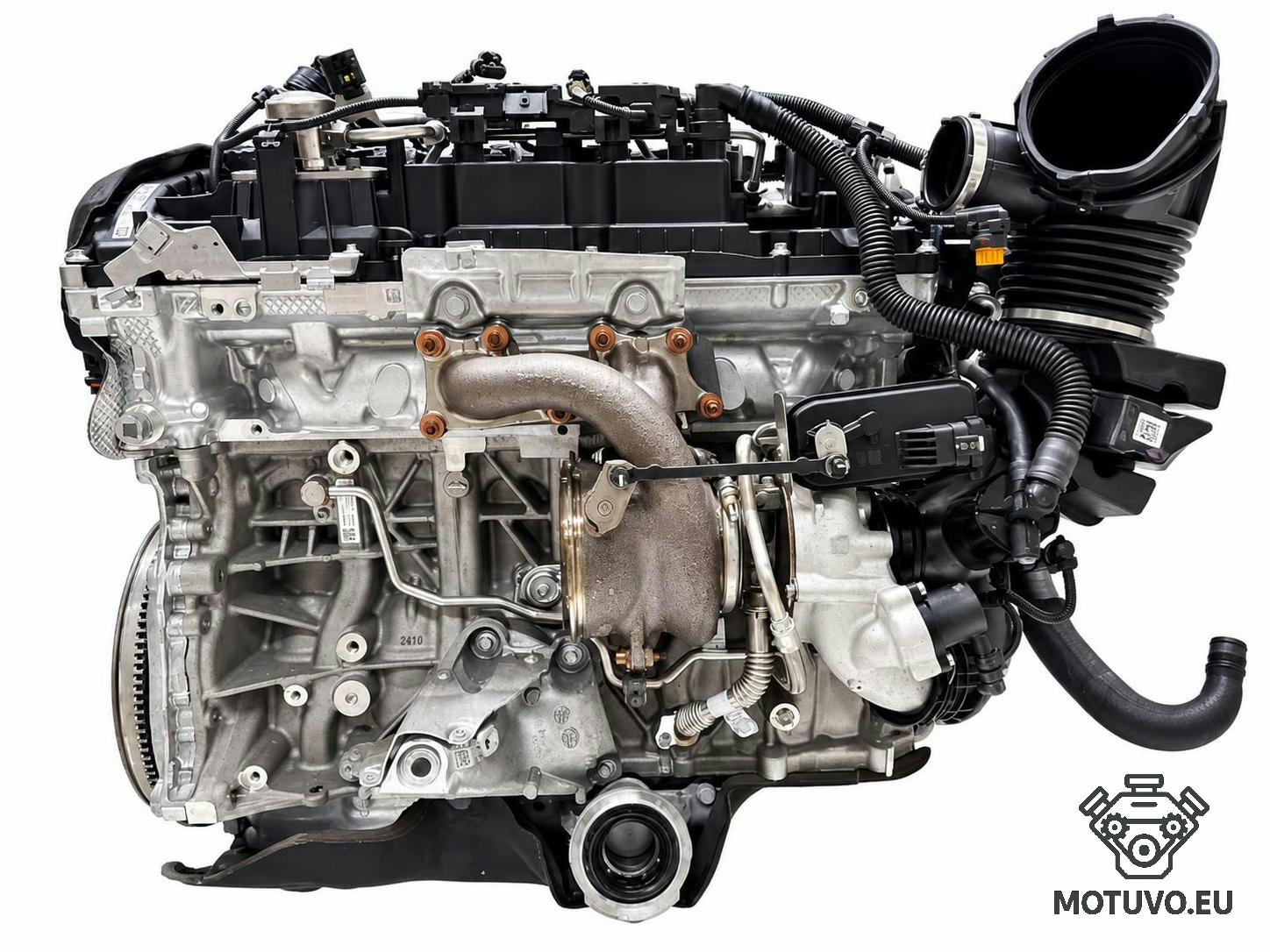
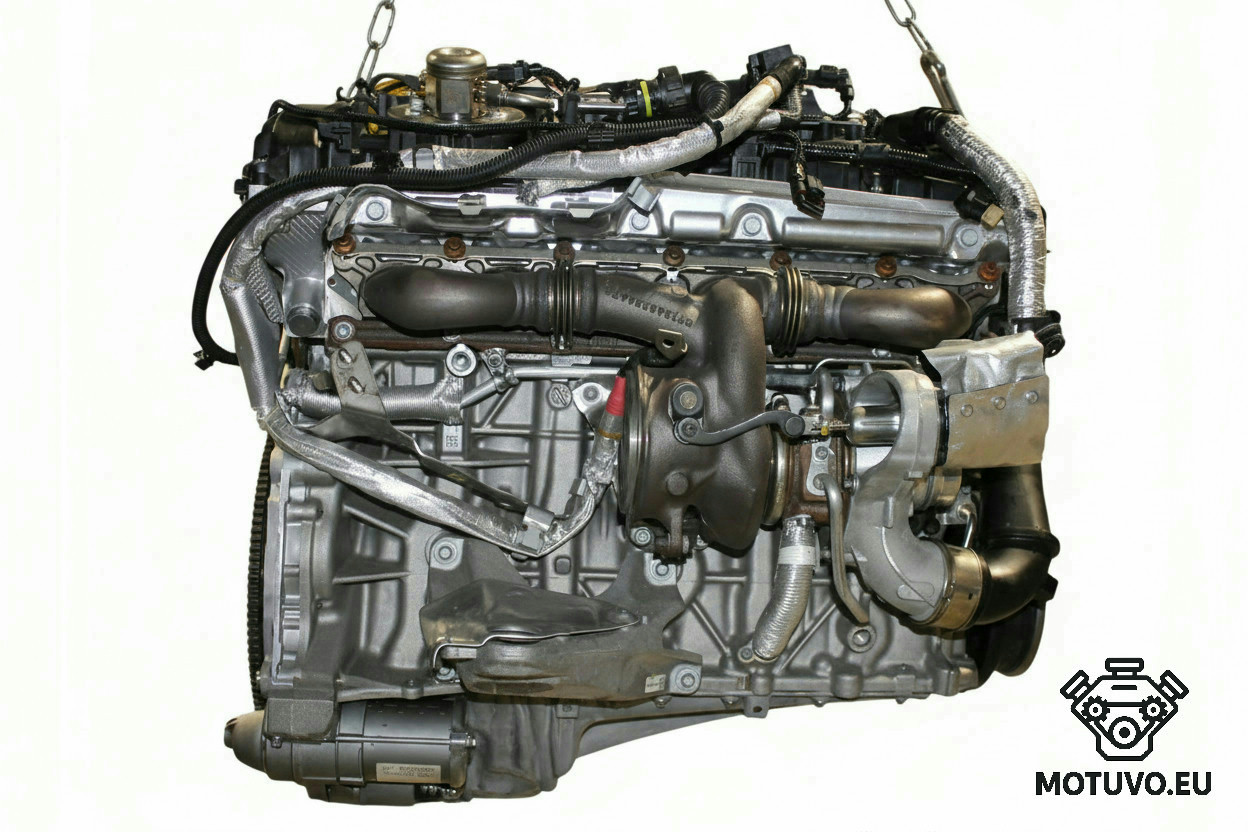
BMW B58B30 Engine Guide – Versions, Applications, Common Problems, Reliability and Replacement Engines
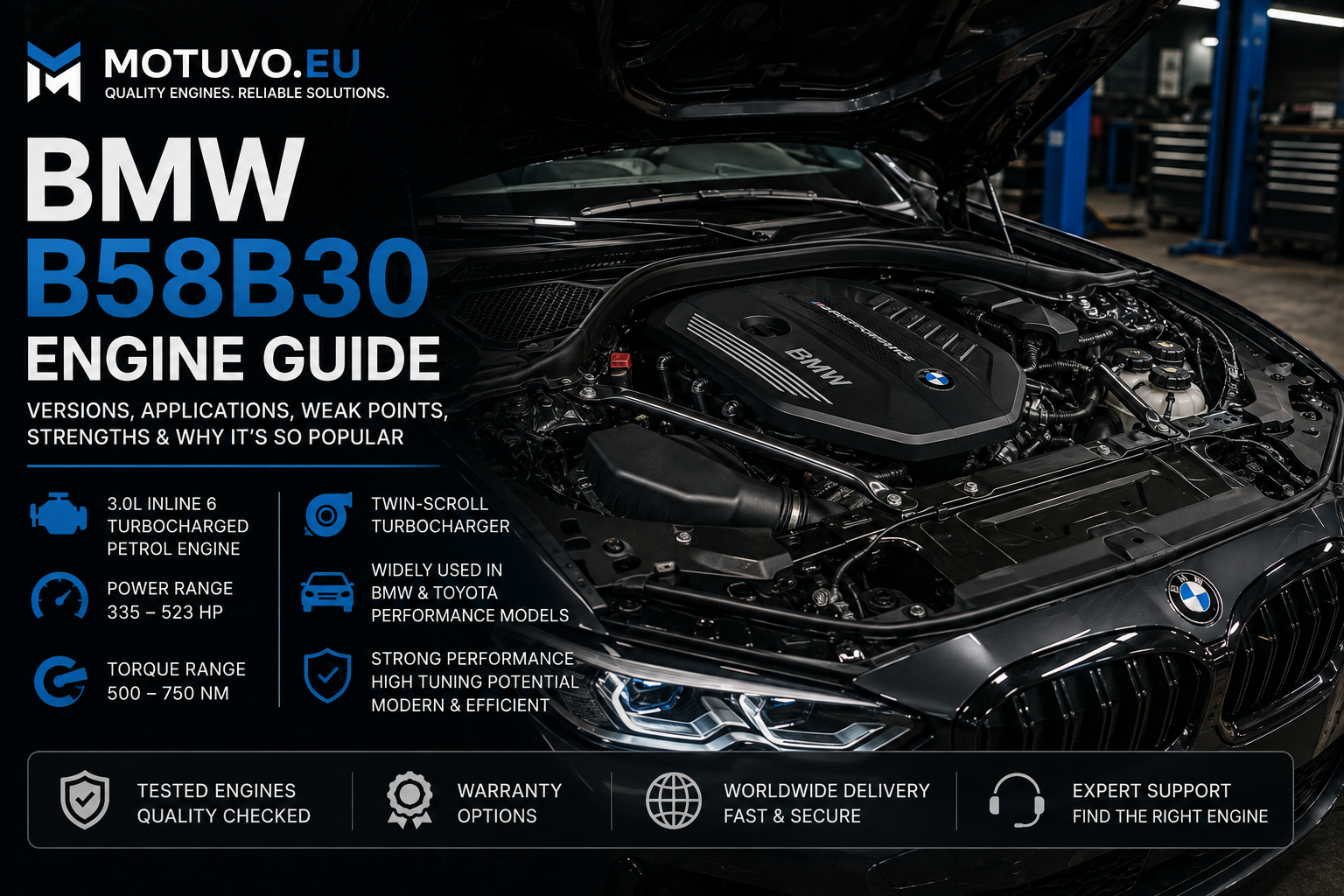
BMW B58B30 Engine Guide – Versions, Applications, Common Problems, Reliability and Replacement Engines
The BMW B58B30 is a 3.0-litre turbocharged inline-six petrol engine introduced in 2015 as the successor to the BMW N55. It quickly became one of BMW’s most popular modern engines because it combines strong performance, smooth power delivery, considerable tuning potential and generally good mechanical reliability.
BMW has used the B58 in everything from luxury saloons and SUVs to M Performance models and sports cars. It also powers the modern Toyota GR Supra 3.0, making the B58 one of the most widely recognised European performance engines of its generation.
Depending on the vehicle, production year and technical revision, the engine may be identified as:
- B58B30M0
- B58B30M1
- B58B30O1
- B58B30M2
- B58B30A
- B58B30B
- B58B30C
- B58 Gen 1
- B58TU or B58 Technical Update
- B58TU2 or second technical update
These names are not always interchangeable. BMW’s official technical designation should be distinguished from the shorter letter-ending codes frequently used by dismantlers, parts databases and replacement-engine sellers.
This guide explains the main BMW B58 versions, their applications, strong points, weak points, popularity, interchangeability and what to check when purchasing a replacement B58 engine.
BMW B58B30 Engine Specifications
| Manufacturer | BMW |
|---|---|
| Engine family | B58 |
| Full family designation | B58B30 |
| Production | From 2015 |
| Fuel type | Petrol |
| Configuration | Inline six-cylinder |
| Displacement | 2,998 cc |
| Bore | 82.0 mm |
| Stroke | 94.6 mm |
| Valvetrain | DOHC, four valves per cylinder |
| Valve-control systems | Double VANOS and Valvetronic |
| Fuel system | High-pressure direct petrol injection |
| Turbocharger | Single twin-scroll turbocharger |
| Charge cooling | Water-to-air intercooling integrated into the intake system |
| Timing system | Timing chain |
| Installation | Longitudinal |
| Typical power range | Approximately 286–392 hp in regular production applications, depending on version and market |
| Typical torque range | Approximately 450–540 Nm |
| Drivetrain applications | Rear-wheel drive and xDrive all-wheel drive |
| Hybrid assistance | 48-volt mild-hybrid technology on selected later versions |
Power ratings vary considerably between countries. North American versions are often advertised with higher SAE horsepower figures than equivalent European models quoted in metric horsepower or kilowatts.
What Does B58B30 Mean?
The BMW engine designation can be interpreted as follows:
- B – BMW modular engine family
- 58 – six-cylinder petrol-engine family
- B – petrol engine
- 30 – approximately 3.0-litre displacement
Additional characters identify the output class and technical revision.
Examples include:
- M0 – original medium-output B58 generation
- M1 – updated medium-output B58TU version
- O1 – higher-output B58TU version
- M2 – later second-update version with further efficiency, combustion and electrical-system changes
BMW B58 Generations and Versions
| Official engine code | Common description | Typical period | Typical applications |
|---|---|---|---|
| B58B30M0 | Original B58 / Gen 1 | Approximately 2015–2020 | 340i, 440i, M140i, M240i, early X3 M40i, 640i GT |
| B58B30M1 | B58TU medium-output version | From approximately 2018/2019 | 540i, 740i, 840i, X5 xDrive40i, X6 xDrive40i, X7 xDrive40i |
| B58B30O1 | B58TU higher-output version | From approximately 2018/2019 | M340i, M440i, M240i, Z4 M40i, X3 M40i, X4 M40i, GR Supra 3.0 |
| B58B30M2 | Second technical update / newer mild-hybrid generation | From approximately 2024, depending on model | Updated M340i, M440i, X3 M50 and selected newer 40i models |
Production overlap exists. A vehicle’s registration year alone is not sufficient to determine its exact B58 version. The VIN and BMW build data should always be checked.
B58B30M0 – Original First-Generation B58
The B58B30M0 was the original production version of the B58. It replaced the N55 in models such as the F30 340i and subsequently appeared across several late F-series and early G-series BMWs.
Common applications include selected versions of:
- F20 and F21 BMW M140i
- F22 and F23 BMW M240i
- F30 and F31 BMW 340i
- F32, F33 and F36 BMW 440i
- G32 BMW 640i Gran Turismo
- Early G01 BMW X3 M40i
- Early G02 BMW X4 M40i
Typical output figures include:
- Approximately 320 hp in early North American 340i applications
- Approximately 326 or 340 metric horsepower in various European models
- Approximately 450–500 Nm, depending on model and calibration
The M0 is popular with tuning enthusiasts because it responds well to ECU software, upgraded fuel systems and larger turbochargers. However, it should not automatically be treated as identical to later B58TU engines.
B58B30M1 – Updated Medium-Output B58TU
The B58B30M1 appeared with the first major technical update of the B58. It is commonly used in 40i models where BMW prioritised strong torque, refinement and efficiency rather than the highest available power rating.
Common applications include selected versions of:
- G11 and G12 BMW 740i and 740Li
- G30 and G31 BMW 540i
- G14, G15 and G16 BMW 840i
- G05 BMW X5 xDrive40i
- G06 BMW X6 xDrive40i
- G07 BMW X7 xDrive40i
Some markets also use the M1 designation for lower-output or tax-optimised versions producing approximately 286 hp. Other M1 applications produce around 333–340 hp.
The same M1 family may therefore appear with different software, emissions equipment and quoted output.
B58B30O1 – Higher-Output B58TU
The B58B30O1 is the higher-output first technical-update version and is one of the most desirable B58 engines.
Common applications include selected versions of:
- G20 and G21 BMW M340i xDrive
- G22, G23 and G26 BMW M440i xDrive
- G42 BMW M240i xDrive
- G29 BMW Z4 M40i
- G01 BMW X3 M40i
- G02 BMW X4 M40i
- Toyota GR Supra A90 and A91 3.0
Depending on market and production year, typical output ranges from approximately 340 hp to 382 hp. BMW’s North American 382 hp version produces approximately 500 Nm, while European ratings may differ.
The O1 introduced or incorporated major technical changes compared with the earliest M0 engine. Depending on the exact production version, these can include:
- Revised cylinder-head design
- Exhaust manifold integrated into the cylinder head
- Revised turbocharger arrangement
- Higher-pressure fuel injection
- Updated cooling circuits
- Revised timing and VANOS components
- Updated emissions hardware
- Different ECU and wiring
These differences mean that an O1 should not automatically be sold as a direct replacement for an M0.
B58B30M2 – Second Technical Update
The B58B30M2 is a newer B58 development introduced in selected 2025-model-year vehicles and other recent applications.
BMW revisions include, depending on application:
- 48-volt mild-hybrid assistance
- Revised combustion process
- Miller-cycle operation
- Updated intake-port and combustion-chamber geometry
- Revised injection and ignition systems
- Updated exhaust-gas routing
- Electrically controlled camshaft adjustment
- Switchable exhaust-side valvetrain components
- Additional efficiency and emissions improvements
Confirmed applications include selected newer:
- BMW M340i xDrive
- BMW M440i xDrive
- BMW M440i Gran Coupé
- BMW X3 M50 xDrive
- Selected updated BMW 40i models
In certain markets, the internal-combustion engine and 48-volt system provide a combined output of approximately 386 hp, while later regional specifications may quote different totals.
The M2 is substantially different from an early M0 engine and should be matched very closely when sourced as a replacement.
B58B30A, B58B30B and B58B30C Trade Codes
Used-engine sellers frequently advertise B58 engines using shorter codes such as:
- B58B30A
- B58B30B
- B58B30C
These descriptions appear in dismantler databases, customs records, online marketplaces and engine-rebuilding catalogues. They are useful search terms, but they are not applied consistently enough to create a universal conversion table.
For example, B58B30C is frequently associated with G-series BMW 40i models and the A90 Toyota Supra, but an advertisement using this code does not prove that the complete engine will fit every B58-powered vehicle.
A seller may use a short trade code while BMW’s own build data identifies the same engine more precisely as M0, M1, O1 or M2.
BMW B58 Version Summary
| Version | Generation | Typical model category | Important notes |
|---|---|---|---|
| B58B30M0 | Original B58 | 340i, 440i, M140i, M240i, early M40i | First generation; no automatic compatibility with later B58TU engines |
| B58B30M1 | First technical update | 540i, 740i, 840i, X5/X6/X7 40i | Medium-output version; power varies by market |
| B58B30O1 | First technical update | M340i, M440i, M240i, Z4 M40i, Supra | Higher-output version with substantial hardware revisions |
| B58B30M2 | Second technical update | Newer M340i, M440i, X3 M50 and 40i applications | New combustion technology and 48-volt integration |
| B58B30A/B/C | Trade or catalogue codes | Varies | Must be cross-checked against official BMW data |
Which BMW Models Use the B58?
BMW 1 Series
- F20 M140i
- F21 M140i
BMW 2 Series
- F22 M240i
- F23 M240i Convertible
- G42 M240i xDrive
BMW 3 Series
- F30 340i
- F31 340i Touring
- F34 340i Gran Turismo
- G20 M340i
- G21 M340i Touring
BMW 4 Series
- F32 440i Coupé
- F33 440i Convertible
- F36 440i Gran Coupé
- G22 M440i Coupé
- G23 M440i Convertible
- G26 M440i Gran Coupé
BMW 5 Series
- G30 540i
- G31 540i Touring
BMW 6 Series Gran Turismo
- G32 640i
- G32 640i xDrive
BMW 7 Series
- G11 740i
- G12 740Li
- Selected plug-in hybrid versions using a B58-based combustion engine
BMW 8 Series
- G14 840i Convertible
- G15 840i Coupé
- G16 840i Gran Coupé
BMW Z4
- G29 Z4 M40i
BMW X3
- G01 X3 M40i
- G45 X3 M50 xDrive
BMW X4
- G02 X4 M40i
BMW X5
- G05 X5 xDrive40i
- Selected X5 plug-in hybrid applications using a B58-based engine
BMW X6
- G06 X6 xDrive40i
BMW X7
- G07 X7 xDrive40i
Toyota GR Supra
- A90 Toyota GR Supra 3.0
- A91 Toyota GR Supra 3.0
- Automatic and manual-transmission versions
The precise B58 revision fitted to each model depends on production date and market.
Why Is the BMW B58 So Popular?
The B58 has developed an unusually strong reputation among owners, tuners, workshops and engine suppliers.
Strong Standard Performance
Even standard versions provide strong low-speed torque and rapid acceleration. The engine delivers power smoothly, making it suitable for luxury cars, sports cars and heavy SUVs.
Inline-Six Refinement
The straight-six configuration is naturally well balanced and produces less vibration than many four-cylinder or V6 layouts.
Considerable Tuning Potential
Many B58 versions respond strongly to ECU tuning, upgraded fuel systems, improved cooling and larger turbochargers. Significant power increases are possible without immediately rebuilding the entire engine.
Strong Basic Engine Construction
The engine’s bottom end, crankshaft and cylinder structure have generally proved capable of handling considerably more power than standard output when the engine is correctly tuned and maintained.
Wide Parts and Knowledge Base
The large number of BMW and Toyota applications has created strong aftermarket support, extensive workshop knowledge and good parts availability.
Toyota GR Supra Association
Use in the GR Supra increased global awareness of the B58 and demonstrated that the engine could support both automatic and manual sports-car applications.
BMW B58 Strong Points
- Smooth and refined inline-six operation
- Strong torque across a wide engine-speed range
- Excellent standard performance
- Good fuel efficiency relative to output
- Strong tuning potential
- Robust basic engine architecture
- Effective water-to-air charge cooling
- Good parts and specialist support
- Wide range of BMW applications
- Proven use in the Toyota GR Supra
- Generally better reliability reputation than several earlier BMW turbo-petrol engines
BMW B58 Common Problems and Weak Points
The B58 is generally reliable, but no modern high-output turbocharged engine is free from faults. Several recurring problems should be considered when buying, maintaining or replacing one.
1. Cooling-System and Coolant-Loss Problems
The B58 uses a complex cooling system with multiple circuits, plastic connections, electric control components and an integrated charge cooler.
Possible leakage points include:
- Water pump
- Thermostat or heat-management components
- Expansion tank
- Coolant hoses and plastic connectors
- Oil-filter housing area
- Charge-cooler circuit
- Turbocharger coolant lines
Possible symptoms include:
- Falling coolant level
- Coolant smell
- White residue around hose connections
- Engine-temperature warning
- Reduced heater performance
- Visible coolant beneath the vehicle
Coolant loss should be investigated quickly because overheating can damage the cylinder head, head gasket and turbocharger.
2. Oil-Filter Housing and Oil Leaks
Oil leakage can develop around the oil-filter housing, seals, cover areas and connected cooling components.
Potential symptoms include:
- Oil smell after driving
- Oil residue on the engine
- Oil collecting on the undertray
- Falling engine-oil level
- Smoke when oil reaches hot exhaust components
The source should be identified accurately because oil can travel across the engine and make the original leak difficult to locate.
3. Valve-Cover and Crankcase-Ventilation Problems
The crankcase-ventilation system is integrated into the valve-cover assembly on many B58 versions.
A ventilation fault may cause:
- Whistling noise
- Rough idle
- Increased oil consumption
- Excessive crankcase vacuum or pressure
- Oil in the intake system
- Oil leakage from seals
- Mixture or air-leak fault codes
In some cases, repair requires replacement of the valve-cover assembly rather than only a separate breather valve.
4. Direct-Injector Problems
High-pressure direct injectors can develop internal leakage, poor spray patterns or electrical faults.
Possible symptoms include:
- Difficult starting
- Rough idle
- Misfire
- Fuel smell
- Black smoke
- Increased fuel consumption
- Fuel dilution of the engine oil
- Spark-plug fouling
A leaking injector can wash lubricant from the cylinder wall and may damage a piston, cylinder or catalytic converter.
5. High-Pressure Fuel-Pump Problems
The high-pressure pump supplies the direct-injection system. A failing pump may cause:
- Extended cranking
- Failure to start
- Fuel-pressure fault codes
- Reduced performance
- Misfire under load
- Limp-home mode
Fuel quality, pump revision and engine version should be considered during diagnosis.
6. Ignition-Coil and Spark-Plug Problems
Ignition components are common service items, particularly on tuned engines or vehicles driven under high load.
Symptoms include:
- Misfire during acceleration
- Shaking at idle
- Reduced power
- Check-engine light
- Poor cold starting
Modified engines may require a different spark-plug specification or reduced replacement interval.
7. VANOS and Valvetronic Faults
The B58 uses variable camshaft timing and variable valve lift.
Possible fault areas include:
- VANOS control valves
- Camshaft actuators
- Valvetronic motor
- Eccentric-shaft system
- Position sensors
- Oil-pressure-related control problems
Possible symptoms include:
- Uneven idle
- Reduced power
- Poor throttle response
- Camshaft timing faults
- Extended cranking
- Limp-home mode
8. Turbocharger and Wastegate Problems
The single twin-scroll turbocharger is generally strong, but faults can develop with mileage, poor lubrication or aggressive tuning.
Possible problems include:
- Wastegate wear or rattle
- Electronic actuator failure
- Oil leakage
- Bearing wear
- Boost leak
- Cracked or loose charge pipes
- Underboost or overboost faults
Possible symptoms include:
- Loss of power
- Whistling or siren noise
- Rattle from the turbocharger area
- Blue smoke
- Boost-pressure fault codes
- Limp-home mode
9. Charge-Cooling System Problems
The B58 uses a water-to-air intercooler incorporated into the intake system.
Possible problems include:
- Low coolant in the charge-cooling circuit
- Electric pump failure
- Air trapped in the cooling circuit
- Heat-exchanger leakage
- Reduced cooling efficiency
Poor charge cooling can reduce power and increase intake-air temperatures, especially on tuned vehicles.
10. Carbon Deposits
Like other direct-injection petrol engines, the B58 can develop deposits in the intake system because fuel does not wash the rear of the intake valves.
Possible symptoms include:
- Rough idle
- Hesitation
- Misfire
- Reduced airflow
- Loss of performance
Carbon accumulation is not always as severe as on some earlier BMW engines, but it remains possible at higher mileage.
11. Timing-Chain and Guide Wear
The B58 uses a timing chain positioned toward the rear of the engine.
Possible symptoms of timing-system wear include:
- Rattle during cold starting
- Metallic noise
- Camshaft and crankshaft correlation faults
- Difficult starting
- Reduced performance
Major timing-chain failure is not considered the B58’s most common problem, but rear-engine placement makes repairs labour-intensive.
12. Modified-Engine Damage
The B58’s popularity means many used engines have been tuned.
Potential risks include:
- Excessive boost pressure
- Poor-quality ECU software
- Incorrect fuel mixture
- Insufficient octane rating
- Repeated launch-control use
- Overheating
- Fuel-system limitations
- Transmission overload
- Piston or connecting-rod damage
A used B58 should be checked for evidence of tuning even if the ECU has been returned to standard software.
Is the BMW B58 Reliable?
Overall, the B58 is considered one of BMW’s more successful modern petrol engines.
Its basic internal construction is strong, and serious mechanical failures are less common than minor cooling, ventilation, ignition or fuel-system problems.
Long-term reliability depends on:
- Regular engine-oil changes
- Correct BMW-approved oil
- High-quality fuel
- Cooling-system condition
- Proper turbocharger lubrication
- Healthy fuel injectors
- Correct spark plugs and ignition coils
- Responsible ECU tuning
- Allowing the engine to warm before high-load use
- Preventing repeated overheating
A standard, correctly maintained B58 is normally a safer purchase than a heavily modified example with an unknown tuning and maintenance history.
How Long Can a B58 Engine Last?
There is no fixed lifespan, but properly maintained engines can achieve high mileage without requiring a complete rebuild.
Engine life depends heavily on:
- Oil-change frequency
- Driving style
- Warm-up habits
- Cooling-system maintenance
- Standard or modified output
- Fuel quality
- Previous overheating
- Injector condition
- Turbocharger condition
Mileage alone does not determine condition. A standard high-mileage motorway engine can be healthier than a low-mileage engine that has experienced repeated cold starts, launch control and aggressive tuning.
Are B58B30M0, M1, O1 and M2 Engines Interchangeable?
They should not be assumed to be directly interchangeable.
Differences can include:
- Cylinder head
- Exhaust-manifold design
- Turbocharger
- High-pressure fuel pump
- Fuel injectors
- Intake manifold and charge cooler
- Oil-filter housing
- Cooling system
- Engine wiring
- ECU and security coding
- 48-volt equipment
- Oil sump
- Engine mounts
- Rear-wheel drive or xDrive installation
- Emissions equipment
- Transmission and flywheel or flexplate
Some versions may share a compatible basic long block, but this should be confirmed from BMW parts data before purchase.
Can a B58B30M0 Replace a B58B30O1?
Normally not as a complete plug-and-play engine.
The O1 technical update includes major changes to the cylinder head, exhaust routing, fuel system, cooling system and electronics.
A specialist may sometimes adapt a compatible base engine by transferring original components, but the conversion must be assessed carefully.
Can a BMW B58 Engine Fit a Toyota GR Supra?
The Toyota GR Supra 3.0 uses a B58-family engine, but not every BMW B58 is a direct Supra replacement.
Possible differences include:
- Engine specification and production revision
- Oil sump
- Engine mounts
- Wiring harness
- ECU and immobiliser integration
- Cooling pipes
- Intake equipment
- Exhaust and emissions components
- Automatic or manual transmission equipment
A BMW donor engine may sometimes provide a compatible long block, but the donor VIN and exact engine code must be checked.
Rear-Wheel Drive vs xDrive B58 Engines
Rear-wheel-drive and xDrive engines can share the same B58 family code but use different external components.
Possible differences include:
- Oil sump
- Oil pickup
- Front differential clearance
- Engine mounts
- Ancillary brackets
- Cooling pipes
- Transmission interfaces
The sump and related components may need to be transferred from the original engine.
What to Check Before Buying a Used B58 Engine
Request the following information:
- Complete official engine code
- Engine serial number
- Donor VIN
- Donor model
- Production date
- Recorded mileage
- Service history
- Cold-start video
- Compression-test results
- Cylinder-leakage results
- Oil-pressure information
- Cooling-system pressure-test results
- Injector condition
- Turbocharger condition
- Evidence of ECU tuning
- Warranty terms
Also confirm exactly what is included:
- Bare block
- Short block
- Long block
- Complete engine
- Turbocharger
- Fuel injectors
- High-pressure fuel pump
- Intake manifold and charge cooler
- Alternator
- Starter motor
- Air-conditioning compressor
- Wiring harness
- Flywheel or flexplate
Used, Rebuilt or Remanufactured B58?
Used B58 Engine
Advantages:
- Lower purchase price
- Original BMW components
- Fast availability
- Good option when mileage and donor history are verified
Disadvantages:
- Unknown tuning history
- Possible hidden overheating
- Existing injector or turbocharger wear
- Possible coolant or oil leaks
- Limited warranty
Rebuilt B58 Engine
A comprehensive rebuild may include:
- New main and connecting-rod bearings
- New piston rings
- Piston inspection or replacement
- Cylinder measurement
- Crankshaft measurement
- Cylinder-head overhaul
- Timing-chain replacement
- Valve and valve-seat inspection
- Oil-pump inspection
- Injector testing
- Turbocharger inspection
Ask for a written report showing exactly which parts were replaced and which measurements were performed.
Remanufactured B58 Engine
A remanufactured engine should be restored according to documented measurements and technical tolerances.
It may include:
- Complete disassembly
- Crack testing
- Dimensional inspection
- New wear components
- Reconditioned cylinder head
- New timing components
- Oil-pressure testing
- Compression testing
- Longer warranty
BMW B58 Maintenance Recommendations
- Change the engine oil more frequently than the maximum extended service interval
- Use the correct BMW-approved oil specification
- Use high-quality petrol with the recommended octane rating
- Allow the engine oil to warm before heavy acceleration
- Do not ignore coolant loss
- Pressure-test the cooling system when leakage is suspected
- Replace spark plugs at the correct interval
- Inspect ignition coils when misfires develop
- Repair injector faults promptly
- Maintain the charge-cooling system
- Inspect crankcase ventilation
- Allow the turbocharger to cool after prolonged high-load use
- Use conservative, professionally calibrated tuning software
- Monitor fuel pressure and mixture on modified engines
- Check the engine-oil level regularly
Frequently Asked Questions About the BMW B58
Is the B58 a 3.0-litre engine?
Yes. The B58 has a displacement of 2,998 cc and is marketed as a 3.0-litre engine.
Is the B58 a twin-turbo engine?
No. Standard B58 engines use one twin-scroll turbocharger. “TwinPower Turbo” is BMW’s technology branding and does not mean that the engine has two turbochargers.
What engine replaced the BMW N55?
The B58 replaced the N55 in models such as the F30 340i.
What is the difference between B58B30M0 and B58B30O1?
The M0 is the original B58 generation. The O1 is a later, higher-output technical-update version with significant changes to the cylinder head, exhaust routing, fuel system, turbocharger arrangement, cooling and electronics.
What is B58B30M1?
The M1 is a medium-output B58 technical-update version commonly used in 40i models such as the 540i, 740i, 840i, X5 xDrive40i and X7 xDrive40i.
What is B58B30M2?
The M2 is a newer second-update engine used in selected recent BMW models. It incorporates additional efficiency, combustion and 48-volt mild-hybrid developments.
Is B58B30C the same as B58B30O1?
The codes may overlap in some trade catalogues, but they should not be assumed to be identical. B58B30C is often a dismantler or marketplace description, while B58B30O1 is an official BMW technical designation.
Which cars use the B58?
B58 applications include BMW 140i, 240i, 340i, 440i, 540i, 640i, 740i, 840i, M340i, M440i, X3 M40i, X4 M40i, X5 40i, X6 40i, X7 40i, Z4 M40i and the Toyota GR Supra 3.0.
Is the BMW B58 reliable?
The B58 generally has a strong reliability reputation. Common problems more often involve cooling components, oil leaks, crankcase ventilation, ignition parts, injectors or auxiliary systems rather than the basic engine block.
Does the B58 use a timing chain?
Yes. The B58 uses a timing chain positioned toward the rear of the engine.
Can a Toyota Supra B58 fit a BMW?
A Supra engine may share the same basic B58 architecture, but direct compatibility depends on the official engine version, sump, wiring, cooling equipment, transmission and electronics.
How much power can a B58 handle?
The B58 has considerable tuning potential, but safe output depends on the engine version, fuel system, turbocharger, cooling, fuel quality and tuning calibration. There is no single safe limit for every B58.
Find the Correct BMW B58 Replacement Engine at MOTUVO
If your BMW or Toyota GR Supra requires a replacement B58B30 engine, MOTUVO can help identify and source the correct version.
The B58 family includes:
- B58B30M0
- B58B30M1
- B58B30O1
- B58B30M2
- B58B30A
- B58B30B
- B58B30C
- First-generation B58 engines
- B58 technical-update engines
- Later 48-volt mild-hybrid versions
- BMW rear-wheel-drive and xDrive configurations
- Toyota GR Supra applications
Choosing an engine based only on the description “BMW B58” or “3.0 turbo” can result in receiving an incompatible cylinder head, turbocharger, fuel system, oil sump, wiring harness or cooling system.
MOTUVO checks replacement-engine compatibility using:
- Vehicle VIN
- Official BMW engine designation
- Engine serial number
- Model and production date
- Power output
- Rear-wheel drive or xDrive
- Transmission type
- 12-volt or 48-volt electrical system
- Original engine equipment
- Emissions specification
We can help source:
- Tested used BMW B58 engines
- Rebuilt B58B30 engines
- Remanufactured B58 engines
- Bare engines and compatible long blocks
- Complete B58 engines with selected accessories
- BMW and Toyota GR Supra replacement units
Send MOTUVO your VIN and complete original engine number to receive a quote for the correct replacement engine.
Find your BMW B58B30 replacement engine at MOTUVO.EU.