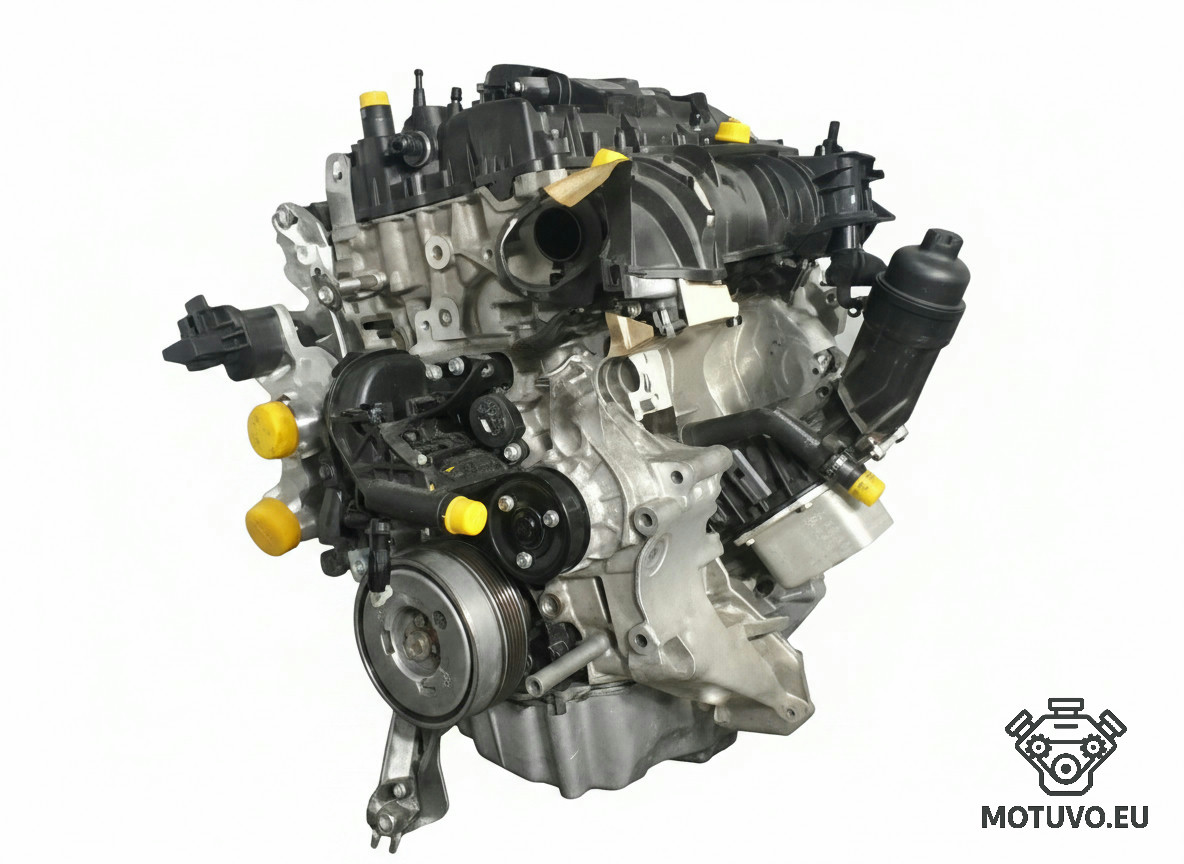
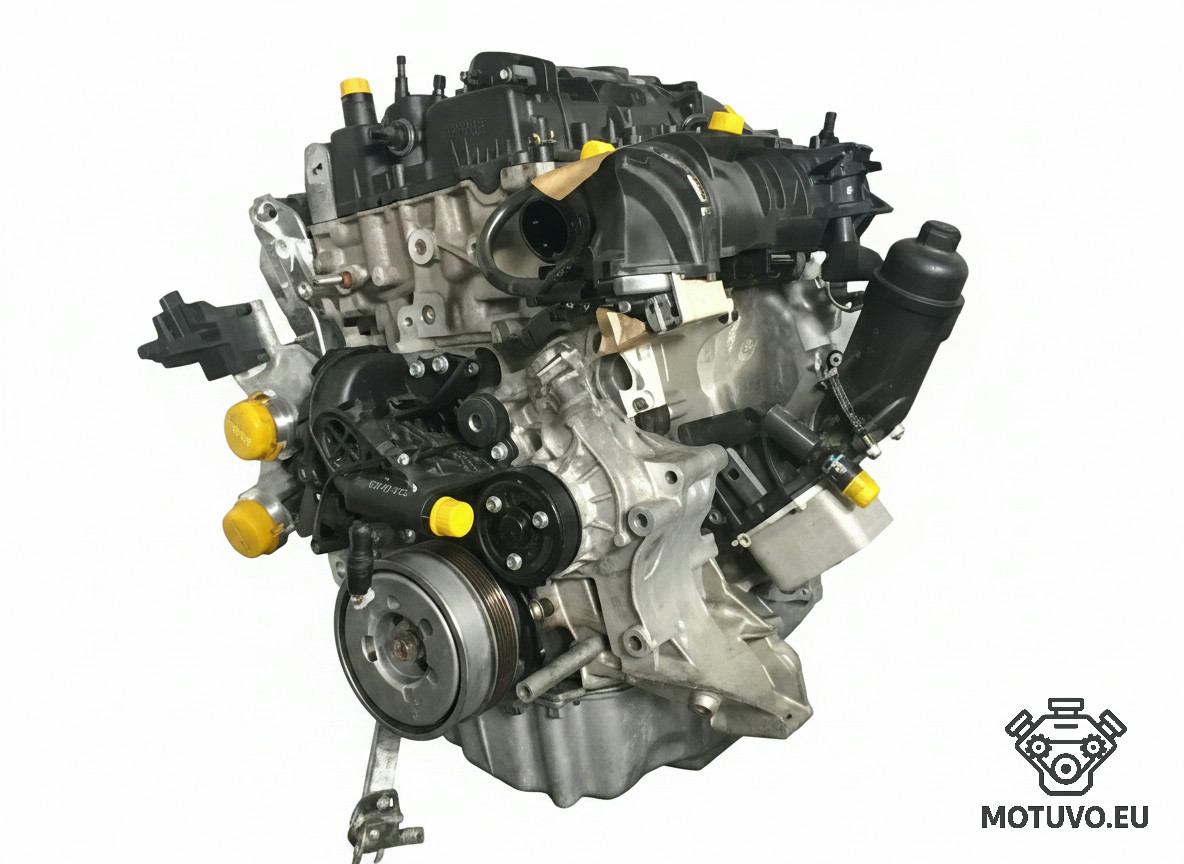
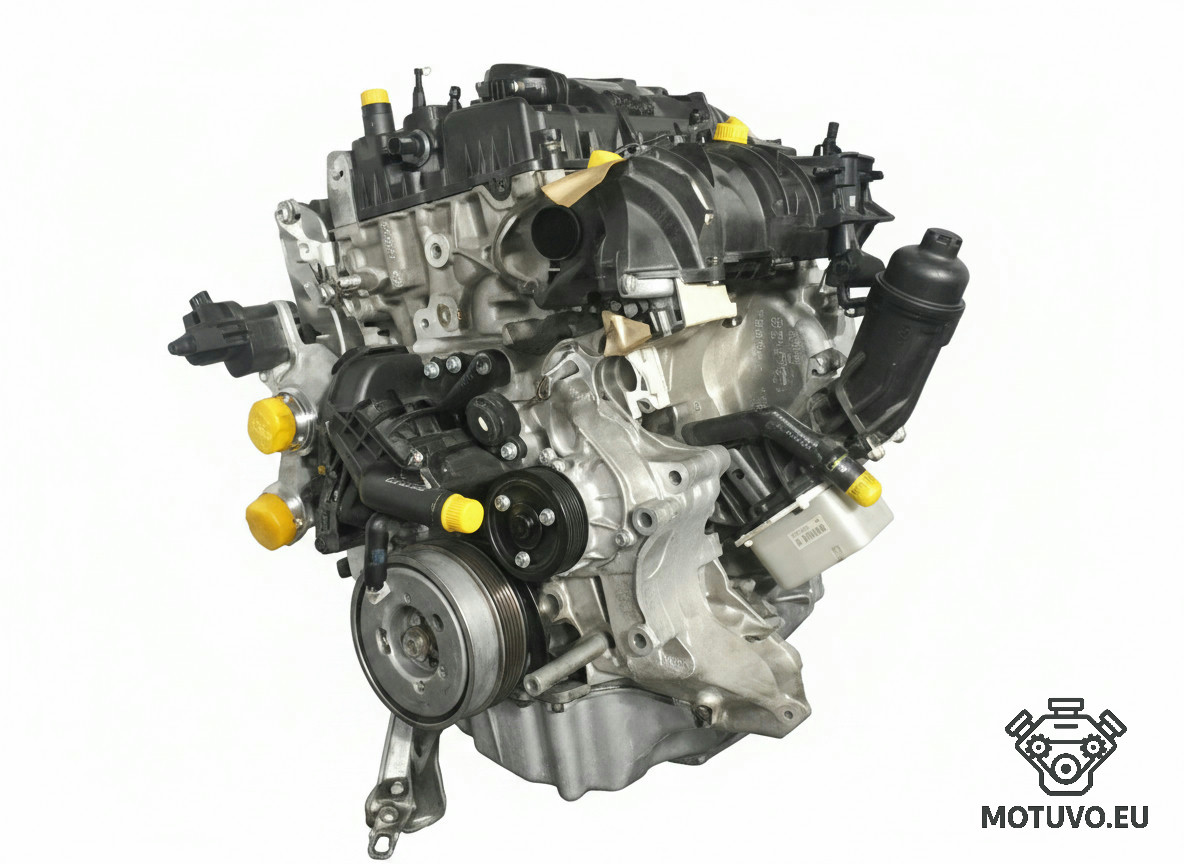
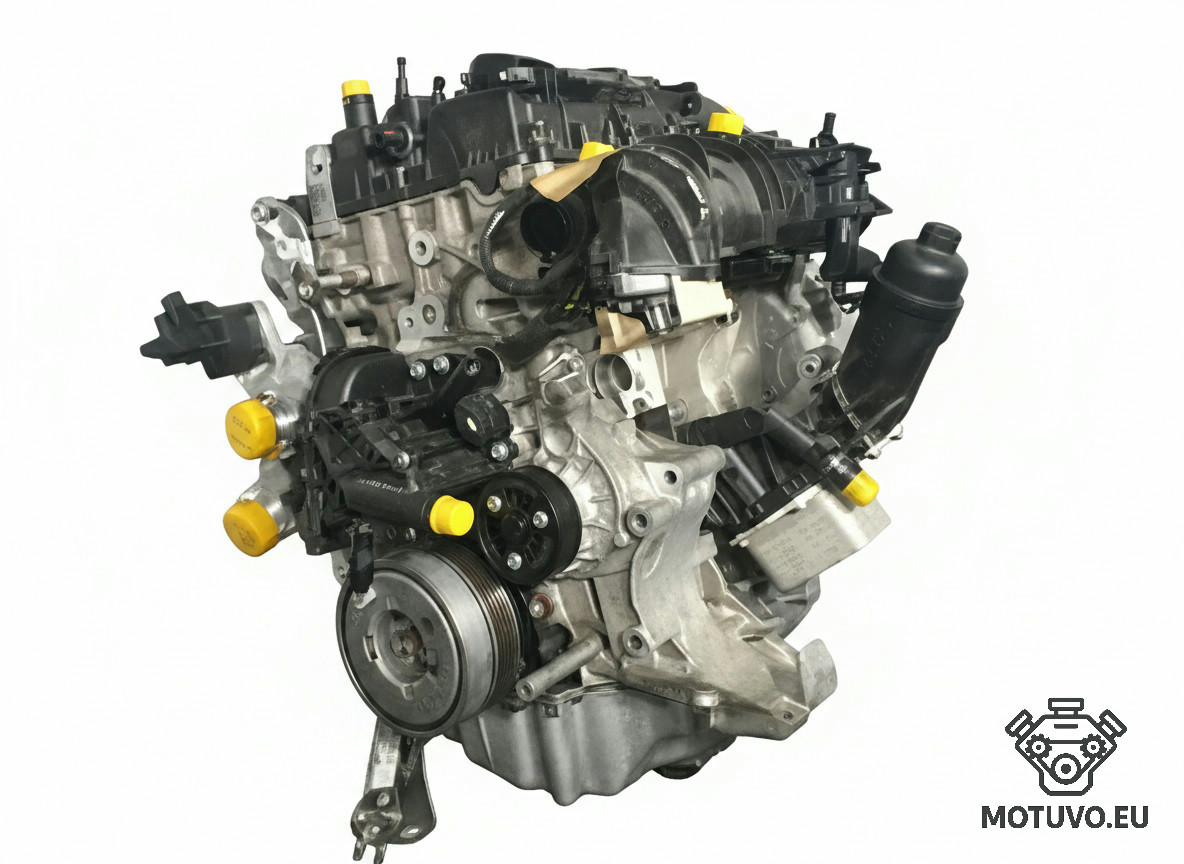
BMW B38B15A Engine Guide – BMW & MINI Applications, Common Problems, Strong Points and Replacement Engines
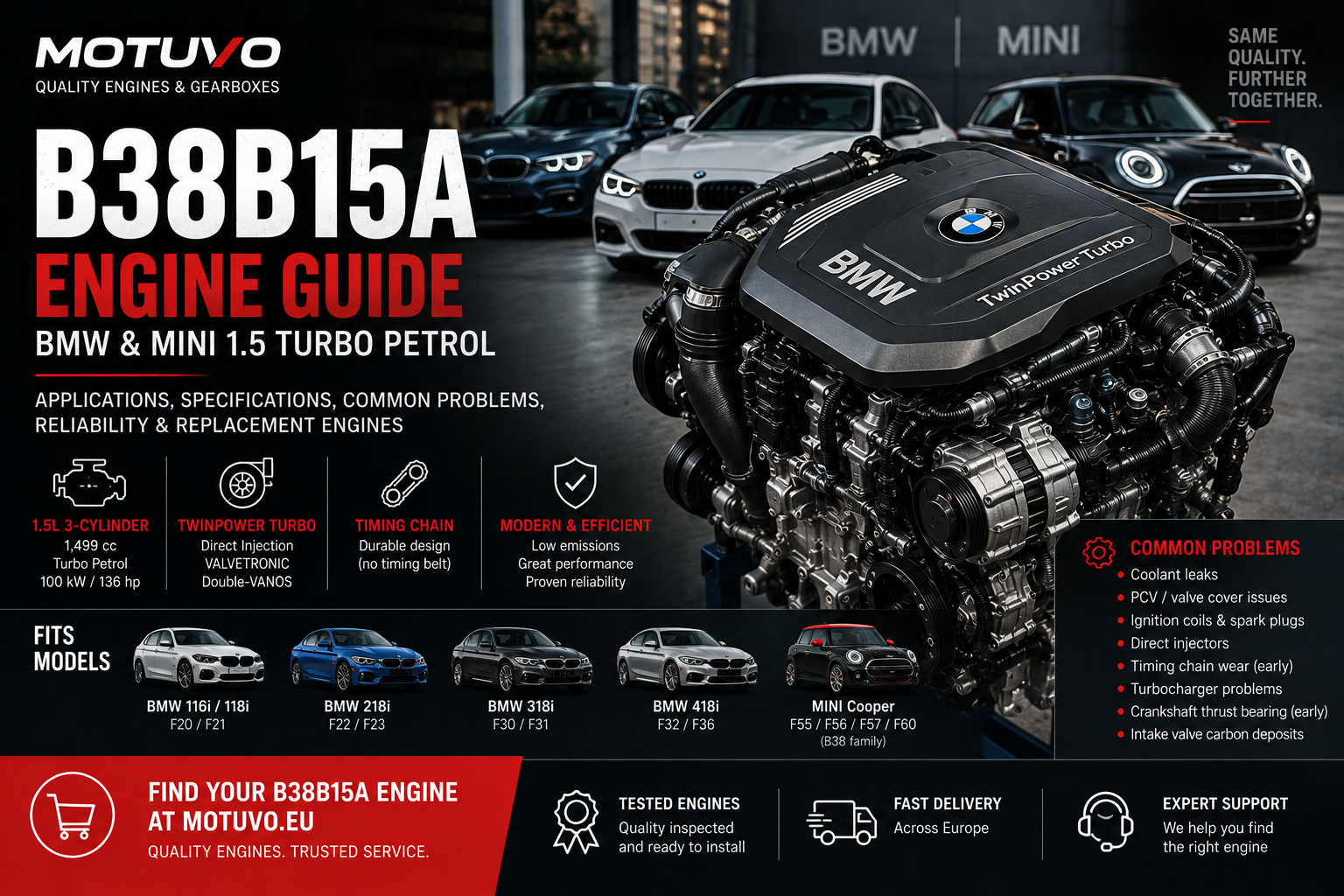
BMW B38B15A Engine Guide – BMW & MINI Applications, Common Problems, Strong Points and Replacement Engines
The BMW B38B15A is a 1.5-litre three-cylinder turbocharged petrol engine from BMW’s modular B-series family. It is one of the most common small petrol engines used across modern BMW and MINI models and is particularly well known from the BMW 118i, 218i and 318i, as well as MINI Cooper applications.
The B38 family was introduced as part of BMW’s modular engine strategy, alongside the four-cylinder B48 and six-cylinder B58. The 1.5-litre version uses approximately 500 cc per cylinder and combines:
- Turbocharging
- Direct petrol injection
- Double-VANOS variable camshaft timing
- VALVETRONIC variable valve lift
- Aluminium construction
- Timing-chain drive
The exact B38B15A code is most commonly associated with longitudinal rear-wheel-drive BMW applications, while closely related B38A15 variants are used in transverse BMW and MINI platforms. This distinction is important when buying a replacement engine because two 1.5-litre B38 engines may share much of their basic architecture while having different sumps, mounts, intake systems, transmissions and ancillary components.
This guide explains the B38B15A’s specifications, BMW and MINI applications, popularity, strong points, common weak points, interchangeability and what to consider before ordering a replacement engine.
BMW B38B15A Engine Specifications
| Manufacturer | BMW Group |
|---|---|
| Engine family | B38 |
| Engine code | B38B15A |
| Fuel type | Petrol |
| Configuration | Inline three-cylinder |
| Displacement | 1,499 cc |
| Aspiration | Turbocharged |
| Fuel system | Direct petrol injection |
| Valve train | DOHC, four valves per cylinder |
| Variable cam timing | Double-VANOS |
| Variable valve lift | VALVETRONIC |
| Timing drive | Timing chain |
| Common output | Approximately 100 kW / 136 hp |
| Lower-output versions | Approximately 80 kW / 109 hp in selected models |
| Typical torque | Approximately 220 Nm depending on version |
| Installation | Longitudinal in B38B15A BMW applications |
BMW’s B38 technical documentation confirms the three-cylinder turbocharged layout and the use of integrated crankcase ventilation and VANOS/VALVETRONIC systems. :contentReference[oaicite:0]{index=0}
Understanding B38B15A vs B38A15A
One of the most important points when buying a B38 replacement engine is the difference between the B38B15 and B38A15 families.
As a practical rule:
- B38B15 variants are associated mainly with longitudinal BMW installations.
- B38A15 variants are associated mainly with transverse BMW and MINI installations.
This does not mean the engines are unrelated. They share the same basic modular design, but complete assemblies can differ considerably.
Possible differences include:
- Oil sump
- Engine mounts
- Turbocharger orientation
- Intake manifold
- Exhaust routing
- Cooling pipes
- Wiring harness
- Flywheel or flexplate
- Transmission interface
- Accessory brackets
A MINI Cooper B38 should therefore not automatically be sold as a complete plug-and-play replacement for a BMW 318i B38B15A.
Which BMW Models Use the B38B15A?
The B38B15A is particularly common in rear-wheel-drive BMW models introduced during the middle of the 2010s.
| BMW model | Chassis | Typical version | Typical output |
|---|---|---|---|
| BMW 116i | F20 / F21 | 1.5 turbo petrol | Approximately 109 hp |
| BMW 118i | F20 / F21 | 1.5 turbo petrol | Approximately 136 hp |
| BMW 218i Coupé | F22 | 1.5 turbo petrol | Approximately 136 hp |
| BMW 218i Convertible | F23 | 1.5 turbo petrol | Approximately 136 hp |
| BMW 318i | F30 | 1.5 turbo petrol | Approximately 136 hp |
| BMW 318i Touring | F31 | 1.5 turbo petrol | Approximately 136 hp |
| BMW 418i Coupé | F32 | 1.5 turbo petrol | Approximately 136 hp |
| BMW 418i Gran Coupé | F36 | 1.5 turbo petrol | Approximately 136 hp |
Public application catalogues consistently identify B38B15A in the F20/F21 116i and 118i, F22/F23 218i, F30/F31 318i and F32/F36 418i. :contentReference[oaicite:1]{index=1}
BMW 118i F20 / F21 B38B15A
The BMW 118i is one of the most common B38B15A applications in Europe.
Typical specification:
- 1.5-litre three-cylinder turbo petrol
- Approximately 100 kW / 136 hp
- Approximately 220 Nm
- Rear-wheel drive
- Manual or automatic transmission depending on version
For replacement-engine buyers, the 118i is especially important because large numbers of used engines are available from dismantlers.
However, a 118i engine should still be checked against the production date and original vehicle equipment before being used in an 218i, 318i or 418i.
BMW 218i F22 / F23 B38B15A
The F22 218i Coupé and F23 218i Convertible use the same basic longitudinal B38 architecture.
These engines are among the strongest candidates for cross-model long-block compatibility with the 118i and 318i, but complete-engine interchange should still be verified.
Check:
- Production year
- Transmission
- Turbocharger part number
- Engine wiring
- Intake components
- Oil sump and brackets
BMW 318i F30 / F31 B38B15A
BMW introduced the B38 into the facelifted F30/F31 3 Series as the 318i.
Typical output is approximately:
- 100 kW
- 136 hp
- 220 Nm
This is one of the more interesting uses of the B38 because a small three-cylinder engine is installed in a relatively large 3 Series platform.
The engine is adequate for normal driving and fuel economy, although performance is more modest than in the lighter 1 Series and 2 Series.
Application data confirms B38B15A in the facelift F30 and F31 318i. :contentReference[oaicite:2]{index=2}
BMW 418i F32 / F36 B38B15A
Selected 4 Series models also use the 1.5-litre B38B15A.
Common applications include:
- BMW F32 418i Coupé
- BMW F36 418i Gran Coupé
These are mechanically related to the 318i installation, but body-specific ancillary equipment and production revisions still need to be checked before engine substitution.
What About MINI Applications?
MINI uses the same B38 engine family extensively, particularly in the:
- MINI F55 Hatch
- MINI F56 Hatch
- MINI F57 Convertible
- MINI F54 Clubman
- MINI F60 Countryman
Typical models include:
- MINI One
- MINI Cooper
- MINI Cooper Clubman
- MINI Cooper Countryman
However, MINI applications generally use B38A15 transverse variants rather than the longitudinal B38B15A layout.
That distinction is important.
A MINI Cooper 1.5 turbo engine may share the same basic block architecture, pistons, cylinder head family and many internal components, but its complete installation is different from an F20 118i or F30 318i.
BMW-family application data confirms the B38 1.5 in MINI Cooper, Clubman and Countryman as well as BMW 118i, 218i and 318i models. :contentReference[oaicite:3]{index=3}
Why Is the B38B15A So Popular?
The B38B15A has become a very common replacement engine because BMW installed the B38 family across a huge number of cars.
Its popularity comes from several factors:
- Large production numbers
- Use across BMW and MINI
- Good fuel economy
- Euro 6 emissions compliance
- Strong torque for a 1.5-litre engine
- Low vehicle taxation in many European markets
- Relatively simple single-turbo layout
- Wide availability of used parts
Compared with older BMW four-cylinder turbo petrol engines, the B38 has also developed a generally better reliability reputation. Recent specialist summaries commonly describe it as one of BMW’s more dependable modern small petrol engines when correctly maintained. :contentReference[oaicite:4]{index=4}
Strong Points of the B38B15A
1. Efficient Modular Design
The B38 was designed around BMW’s modular 500 cc-per-cylinder concept.
This gives BMW common engineering and manufacturing principles across:
- B38 three-cylinder petrol
- B48 four-cylinder petrol
- B58 six-cylinder petrol
The result is a compact engine with good thermal efficiency and strong specific output.
2. Good Torque at Low RPM
The turbocharger gives the 1.5-litre engine surprisingly strong low-speed performance.
Around 220 Nm from a 1.5-litre engine is enough to make cars such as the 118i and 218i feel responsive in everyday driving.
3. Good Fuel Economy
The combination of:
- Small displacement
- Direct injection
- VALVETRONIC
- Variable cam timing
- Turbocharging
allows relatively low fuel consumption without making the engine feel severely underpowered.
4. Wide Parts Availability
Because the B38 family was used in so many BMW and MINI models, there is good availability of:
- Used engines
- Cylinder heads
- Turbochargers
- Injectors
- Fuel pumps
- Internal components
- Rebuilt engines
5. Generally Strong Base Engine
The B38 does not have the same widespread catastrophic reputation as some older BMW turbo petrol engines.
When serviced correctly, the block, crankshaft and cylinder head can provide high mileage.
Common B38B15A Problems and Weak Points
1. Coolant Leaks
Cooling-system leaks are among the most commonly encountered age-related B38 issues.
Possible leak points include:
- Thermostat housing
- Coolant pipes
- Plastic connectors
- Expansion tank
- Water pump
- Turbocharger cooling lines
Symptoms include:
- Falling coolant level
- Coolant smell
- Dried coolant residue
- Temperature warnings
- Overheating
Specialist reliability reports repeatedly identify plastic cooling-system components and thermostat-related leakage as common B38 age-related faults. :contentReference[oaicite:5]{index=5}
2. Crankcase-Ventilation / PCV Problems
BMW integrates sophisticated crankcase ventilation into the B38 engine.
BMW technical documentation explains that the system regulates crankcase pressure and separates oil from blow-by gases before the gases are returned to the intake. :contentReference[oaicite:6]{index=6}
A failing pressure-control diaphragm or valve-cover assembly can cause:
- Whistling noise
- Rough idle
- Oil leaks
- High crankcase vacuum
- Oil consumption
- Mixture-control faults
3. Ignition Coils and Spark Plugs
Misfires are often caused by ignition components rather than internal engine damage.
Symptoms include:
- Shaking at idle
- Misfire under acceleration
- Check-engine light
- Poor starting
- Reduced power
Before condemning a B38 engine, spark plugs and ignition coils should always be checked.
4. Direct Injector Problems
The B38 uses high-pressure direct petrol injection.
Injector faults can cause:
- Hard starting
- Rough idle
- Misfires
- Fuel smell
- Black smoke
- High fuel consumption
- Fuel dilution of the engine oil
A leaking injector can wash lubricating oil from the cylinder wall and, if ignored, contribute to piston and cylinder wear.
5. High-Pressure Fuel Pump Problems
The direct-injection system also requires a high-pressure fuel pump.
Possible symptoms include:
- Long cranking
- No-start condition
- Loss of power
- Fuel-pressure faults
- Misfire under load
Fuel pressure should be measured before replacing injectors or the pump.
6. Timing-Chain Noise
The B38 uses a timing chain rather than a timing belt.
Timing-chain issues are not as notorious as on the older N47 diesel, but wear can still occur.
Possible symptoms include:
- Cold-start rattle
- Metallic noise
- Camshaft/crankshaft correlation faults
- Difficult starting
- Poor running
Some specialist sources report that early B38 engines are more likely to develop chain tensioner or chain noise than later revisions. :contentReference[oaicite:7]{index=7}
7. Early Crankshaft Thrust-Bearing Concern
One issue that deserves specific attention on some early B38 applications is excessive crankshaft axial movement related to the thrust bearing.
This concern is discussed particularly in connection with early manual-transmission vehicles.
Possible warning signs include:
- Abnormal noise when pressing the clutch
- Change in engine sound with clutch operation
- Excessive crankshaft end float
- Unusual clutch feel
Specialist B38 references identify early manual-transmission engines, particularly around the first production years, as the main group to inspect for thrust-bearing wear. :contentReference[oaicite:8]{index=8}
8. Turbocharger and Wastegate Problems
Turbocharger-related faults may involve:
- Wastegate actuator
- Wastegate linkage
- Turbo bearings
- Oil feed
- Oil return
- Boost hoses
Symptoms include:
- Rattling
- Whistling
- Loss of boost
- Underboost faults
- Blue smoke
- Oil consumption
Before replacing the turbocharger, check crankcase pressure and engine oil supply.
9. Intake-Valve Carbon Deposits
Because the B38 uses direct injection, fuel does not continuously wash the rear of the intake valves.
Oil vapour can therefore accumulate and form carbon deposits.
Possible symptoms include:
- Rough idle
- Cold-start hesitation
- Reduced performance
- Misfires
- Higher fuel consumption
10. Oil Leaks
As mileage increases, leaks may develop around:
- Valve cover
- Oil-filter housing
- Timing cover
- Oil sump
- Turbo oil pipes
- Crankshaft seals
Small leaks should be repaired before they contaminate auxiliary belts or other components.
11. Engine-Mount Wear and Three-Cylinder Vibration
The B38 naturally has a different vibration characteristic from a four- or six-cylinder engine.
BMW uses balancing and engine-mount tuning to control it.
When mounts wear, symptoms may include:
- Excessive vibration at idle
- Shaking when engaging gear
- Knocking under acceleration
- Vibration through the cabin
Not every vibration means that the engine itself is damaged.
Is the B38B15A Reliable?
Overall, yes.
The B38B15A is generally regarded as a solid modern BMW petrol engine when it receives regular maintenance.
Its main advantages are:
- Good fuel economy
- Strong torque for its size
- Relatively simple turbo setup
- Wide parts availability
- Strong basic construction
- Fewer notorious catastrophic weaknesses than several older BMW engine families
The areas that matter most with age are:
- Cooling system
- PCV system
- Ignition components
- Direct injectors
- Timing-chain condition
- Turbocharger
A well-maintained example with clean oil, stable coolant level and no cold-start chain noise can be a very good used engine.
Are All B38B15A Engines Interchangeable?
Not automatically.
The exact B38B15A code significantly narrows the possibilities, but complete engine compatibility can still depend on:
- Production date
- 109 hp or 136 hp output
- Manual or automatic transmission
- Turbocharger revision
- Fuel injectors
- High-pressure pump
- ECU calibration
- Oil sump
- Engine mounting
- Wiring harness
- Emissions specification
For direct replacement, matching the VIN and production date is preferable to relying on the engine code alone.
Can a BMW 118i B38B15A Fit a 318i?
Potentially, yes.
The F20/F21 118i and F30/F31 318i use closely related longitudinal B38B15A engines at approximately 136 hp.
A compatible long block may often be usable.
However, compare:
- Production date
- Engine number
- Turbocharger
- Intake and exhaust equipment
- Engine brackets
- Transmission
- Wiring
For a complete plug-and-play engine, the safest option remains a matching application.
Can a BMW 218i B38B15A Fit a 118i or 318i?
Again, the basic engine is closely related.
The F22/F23 218i is one of the most useful donor candidates when sourcing a longitudinal 136 hp B38B15A.
The long block may be compatible, but vehicle-specific ancillary parts may need to be transferred.
Can a 109 hp B38B15A Replace a 136 hp Version?
Do not assume so.
The engines share the same 1.5-litre architecture, but differences can include:
- ECU calibration
- Turbocharger control
- Fuel-system calibration
- Ancillary equipment
- Emissions specification
For a direct replacement, matching the original kW output is strongly recommended.
Can a MINI B38 Engine Replace B38B15A?
Not as a direct complete-engine replacement.
MINI normally uses transverse B38A15 configurations, while B38B15A BMW models use longitudinal installation.
Differences may include:
- Oil sump
- Engine mounts
- Turbo orientation
- Intake manifold
- Exhaust system
- Cooling pipes
- Transmission interface
- Wiring
A MINI engine may sometimes provide a related bare or long block, but this requires detailed parts comparison.
What to Check Before Buying a Used B38B15A
Before purchasing a replacement engine, request:
- Exact engine code
- Engine serial number
- Donor VIN
- Donor model
- Production date
- Power output in kW
- Mileage
- Service history
- Cold-start video
- Compression-test results
- Leak-down-test results if available
- Oil-pressure information
- Timing-chain noise check
- Injector condition
- Turbocharger condition
- Cooling-system history
- Warranty terms
On an early manual-transmission donor, it is also sensible to ask whether crankshaft end float has been checked.
What Should Be Checked Before Installing a Replacement B38B15A?
With the engine out of the car, several items are easier to inspect.
Depending on mileage and history, check or replace:
- Engine oil and filter
- Spark plugs
- Accessory belt
- Belt tensioner
- Water pump
- Thermostat housing
- Coolant pipes
- Valve-cover / PCV system
- Crankshaft seals if leaking
- Turbo oil and coolant lines
If the donor engine has any cold-start chain noise, the timing system should be investigated before installation.
Used, Rebuilt or Remanufactured B38B15A?
Used B38B15A Engine
Advantages:
- Lower price
- Original BMW components
- Good availability
- Fast replacement
Disadvantages:
- Unknown coolant-leak history
- Unknown timing-chain condition
- Possible injector wear
- Possible turbocharger wear
- Possible early thrust-bearing concerns on some donors
Rebuilt B38B15A Engine
A proper rebuild may include:
- Main bearings
- Connecting-rod bearings
- Piston rings
- Pistons if required
- Cylinder measurement
- Cylinder-head overhaul
- Timing-chain replacement
- Chain guides and tensioner
- Oil-pump inspection
- Injector testing
- Turbocharger inspection
Remanufactured B38B15A Engine
A professionally remanufactured engine should be rebuilt according to measured tolerances.
Typical work may include:
- Complete disassembly
- Crack testing
- Crankshaft measurement
- Cylinder measurement
- New bearings
- New piston rings
- Reconditioned cylinder head
- New timing components
- Oil-pressure testing
- Compression testing
- Warranty
B38B15A Maintenance Recommendations
- Use the correct BMW-approved engine oil
- Change oil and filter regularly
- Avoid excessively extended oil-change intervals
- Monitor coolant level
- Repair coolant leaks early
- Replace spark plugs on schedule
- Investigate misfires promptly
- Check PCV operation if oil consumption rises
- Listen for timing-chain noise during cold starts
- Maintain turbocharger oil and coolant lines
- Use good-quality fuel
- Do not ignore overheating
Frequently Asked Questions About B38B15A
What is the B38B15A?
It is a BMW 1,499 cc turbocharged three-cylinder direct-injection petrol engine from the B38 modular family.
How much power does the B38B15A produce?
The most common version produces approximately 100 kW / 136 hp, while selected lower-output versions produce around 80 kW / 109 hp. :contentReference[oaicite:9]{index=9}
Which BMW models use B38B15A?
Common applications include:
- BMW F20/F21 116i
- BMW F20/F21 118i
- BMW F22/F23 218i
- BMW F30/F31 318i
- BMW F32/F36 418i
Does MINI use B38 engines?
Yes. MINI uses the B38 family extensively, but most MINI applications use transverse B38A15 variants rather than the longitudinal B38B15A configuration. :contentReference[oaicite:10]{index=10}
Does B38B15A use a timing belt?
No. It uses a timing chain.
Is B38B15A reliable?
Generally yes. The engine has a good reputation compared with several older BMW small turbo petrol engines, but cooling system leaks, PCV faults, ignition problems, injectors, turbo wear and timing-chain noise should still be checked.
Can a 118i engine fit a 318i?
Potentially, especially when both are 136 hp B38B15A versions, but production date, ancillaries and transmission configuration should be verified.
Can a MINI Cooper engine fit a BMW 318i?
Not directly as a complete engine. MINI uses a transverse installation while the 318i B38B15A is longitudinal.
What is the biggest weakness of the B38B15A?
There is no single universal catastrophic weakness. Cooling-system leaks, crankcase ventilation, ignition components and age-related timing or turbo issues are more typical. Early manual-transmission engines also deserve attention for crankshaft thrust-bearing wear.
Find the Correct BMW B38B15A Replacement Engine at MOTUVO
If your BMW requires a replacement B38B15A 1.5 turbo petrol engine, MOTUVO can help identify the correct version before you order.
The B38B15A appears in several BMW applications, including:
- BMW 116i F20 / F21
- BMW 118i F20 / F21
- BMW 218i F22 / F23
- BMW 318i F30 / F31
- BMW 418i F32 / F36
The broader B38 family is also widely used in MINI models, but a MINI B38 is not automatically the same complete engine as a BMW B38B15A.
Choosing a replacement engine based only on the description “BMW 1.5 B38” can result in receiving the wrong sump, mounts, turbocharger arrangement, transmission hardware or wiring.
MOTUVO checks compatibility using:
- Vehicle VIN
- Complete B38B15A engine code
- Engine serial number
- Vehicle production date
- Power output
- Manual or automatic transmission
- Original turbocharger specification
- Engine equipment and emissions specification
MOTUVO can help source:
- Tested used B38B15A engines
- Rebuilt B38B15A engines
- Remanufactured B38B15A engines
- Bare engines
- Long blocks
- Complete replacement engines with selected accessories
Send MOTUVO your VIN, production year and original engine number and we can help match the correct B38B15A before you order.
Find your BMW B38B15A replacement engine at MOTUVO.EU.